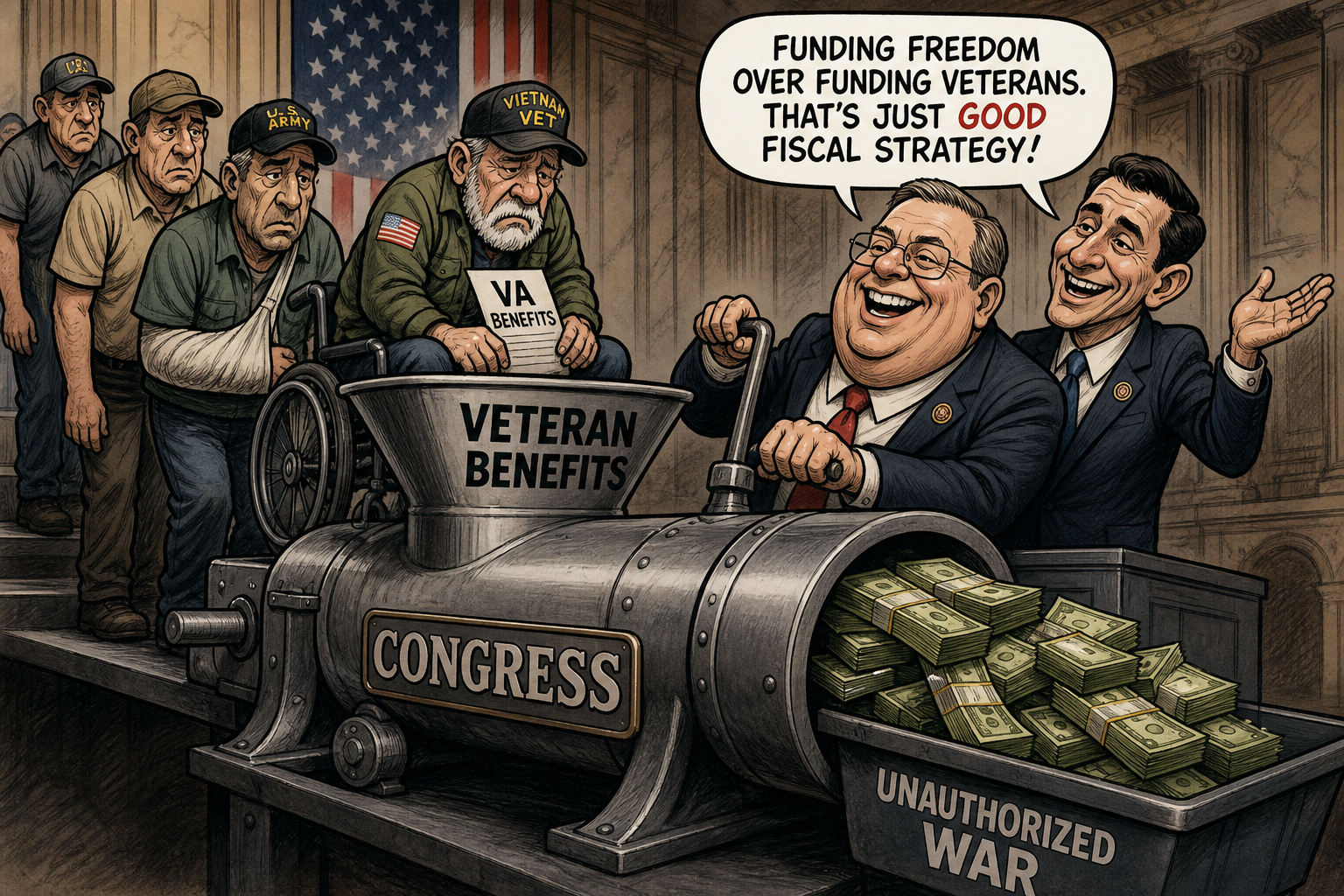
WASHINGTON — The House of Representatives quietly advanced a spending bill this week that would fund the escalating war in Iran by reducing disability payments for future veterans with tinnitus and sleep apnea, aides confirmed Tuesday. The proposal hit the floor as the Pentagon reported $37 billion in expenditures on a conflict Congress has never authorized.
At least 18 American troops have been killed. Over 100 were wounded in the weeks since the July ceasefire collapsed. No vote was held. The White House has asked for tens of billions more, diverting money from training and maintenance to keep the war going. The new legislation, championed by allies of Dickhead Donny, would have paid for some of that by limiting compensation for two of the most common conditions suffered by combat veterans: permanent hearing damage and sleep-disordered breathing.
"The operational tempo in the Persian Gulf requires sustained fiscal discipline," a senior Republican legislative aide said, speaking anonymously to discuss internal strategy. "We're aligning compensation with updated actuarial realities. Helicopters are loud. That's not a new discovery. The taxpayer shouldn't foot an open-ended bill for ears."
The Veterans of Foreign Wars objected immediately. In response, two Republican congressmen asked the VA to investigate the VFW's accreditation—a move one retired flag officer described as "investigating the fire department for reporting a fire." The VA has not responded to a request for comment on whether that investigation would also produce actuarial savings.
An early draft of the bill had carried the working title "Taking Benefits from America's Veterans Act," which congressional staffers say was later revised to something less descriptive. They declined to explain why the original phrasing so precisely captured the policy's central mechanism.
Simultaneously, Secretary of Defense Pete Hegseth has blocked the promotions of several distinguished female officers to admiral, citing a focus on "warfighting readiness." In the middle of a war, the Pentagon also launched a testosterone-evaluation program whose connection to naval dominance remains unexplained. No similar initiative has been proposed for detecting hearing loss.
Maura Sullivan, a former assistant secretary of the VA and Marine Corps veteran, described the sequence as logically bewildering. "They're cutting benefits for injuries caused by their own hardware, while making sure the officers who survive have the right hormone levels," Sullivan said. "I'd call it a cartoon, but cartoons have internal consistency."
The diversion of funds has already opened deficits that Pentagon officials say will degrade training and weapons readiness for a decade, unless the war ends, which would require a vote that is not scheduled. The legislation was pulled after a pressure campaign by veterans' groups. A spokesperson for the House sponsor said it would be reintroduced once "the messaging environment improves." No hearing is scheduled on the long-term fiscal impact of tinnitus.


