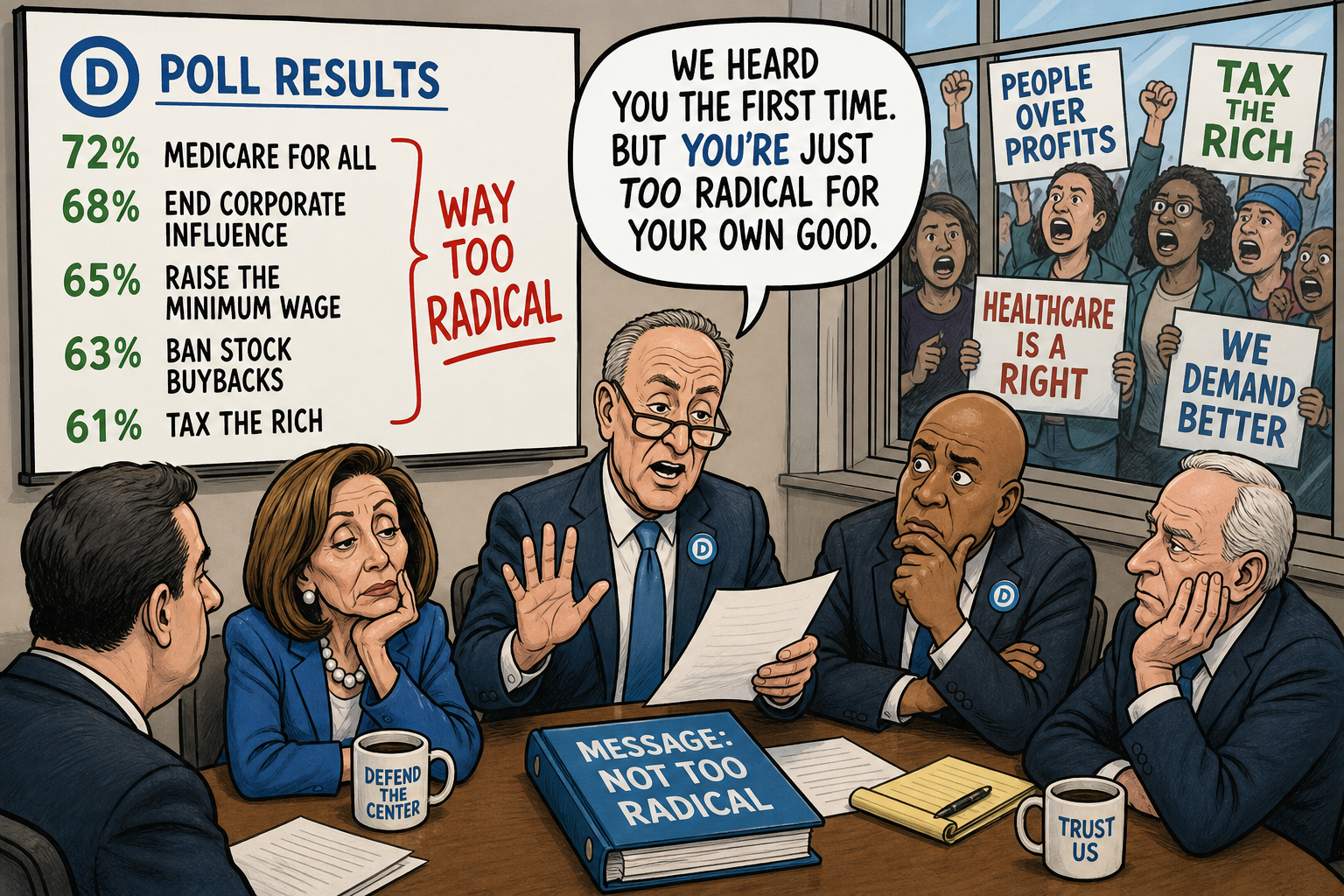
The Democratic National Committee confirmed this week that a health care policy supported by 90 percent of all voters will not be adopted, studied, or mentioned at donor retreats. The decision follows a new YouGov-CBS poll showing that 83 percent of Democratic voters want their party to fight for Medicare for All. Party officials described the findings as aspirational noise.
"We cannot allow popular opinion to dictate policy in an election year," said DNC Deputy Communications Director Marla Sands. "Our job is to lower expectations to a level that is acceptable to the people who fund the party." Sands added that the 90 percent figure reflected a statistical anomaly caused by asking voters what they wanted.
The committee did not dispute the poll. It disputed the idea that the poll should mean anything. A memo sent to staff said voter preferences would be considered only after a series of focus groups, a six-month review, and a careful donor analysis.
The party's political class has lost two of the last three presidential races to Wimpy Donnie Dipshit. It has watched candidates like Angie Nixon and Will Lawrence win primaries by promising single-payer health care. Leadership described those wins as red flags and ordered a review of whether activists were allowed to use the word "all" without permission.
Rep. Ro Khanna told a DNC meeting that people who lost twice to the former president have no standing to call new ideas too radical. Party leaders called the speech interesting and moved on to a panel called Electability: The Courage to Say No. No panelist had ever co-sponsored Medicare for All.
Congressional leaders remain unmoved by a study showing Medicare for All could save the government $1 trillion and 114,000 lives every year. House Minority Leader Hakeem Jeffries said he has not co-sponsored the bill. He said the correct path was to repair the damage done by the former president and then build something better later, after everyone stopped asking.
The repair plan includes extending Affordable Care Act tax credits for 20 million people who pay up to $1,000 more a month in premiums. It does not include letting them stop paying. A spokesperson called the current system sustainable enough.
Michigan candidate Will Lawrence said voters are fed up with both parties taking money from Silicon Valley and Wall Street. He pointed to data center tax breaks approved by a Democratic governor as one source of the frustration. "People see the donor class controlling both parties," he said. "Then they see the party respond to a 90 percent mandate by forming a task force to study why voters feel unheard."
The task force is expected to hold three listening sessions, none of which will conflict with scheduled fundraisers. Its interim report will recommend hiring a consultant to determine whether voters understand the question. A final report is due after the midterms.