WASHINGTON — The U.S. Department of Justice has finalized a settlement agreement that permanently exempts Captain Sharts-a-Lot from all federal tax audits, past and future, according to documents released this week by the department and reviewed by The Rusty Trumpet.
The agreement, signed solely by Acting Attorney General Todd Blanche on May 18, 2026, was presented not as a negotiated deal between two parties but as an internal departmental order. It settles a $10 billion lawsuit the president had filed alleging an IRS data breach. The first disclosed portion established a $1.776 billion fund to compensate individuals prosecuted for their role in the January 6 Capitol attack.
The fund drew immediate criticism from government ethics experts. They noted that the government simultaneously distributed money to convicted rioters and issued itself a liability waiver for any future crimes committed with the funds. Legal experts also noted the one-sided nature of the settlement. Only Blanche’s signature appears on the document. No representative of the IRS, the Treasury Department, or any federal court endorsed it.
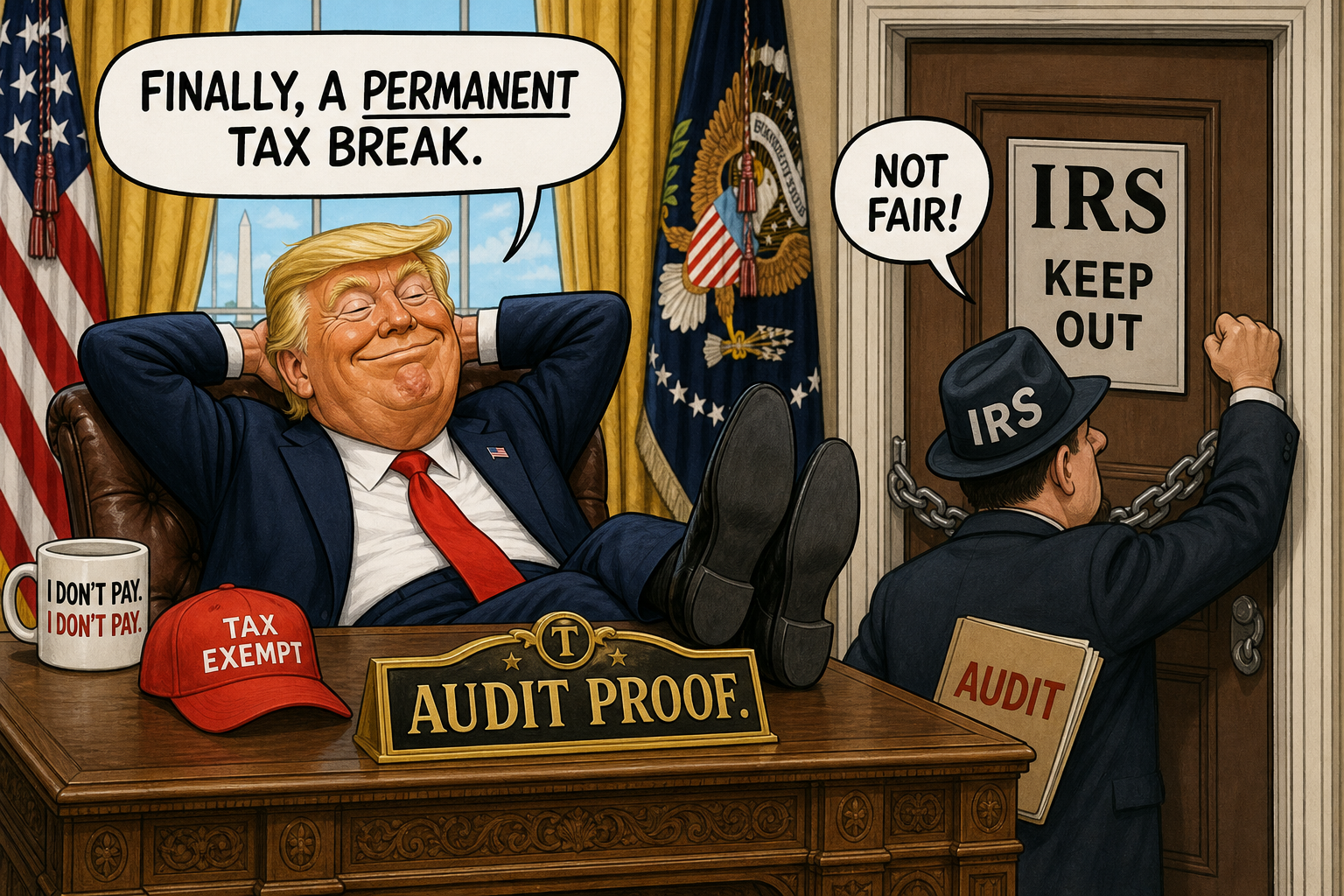
A second document, dated May 19 and characterized by a department spokesperson as a “technical addendum,” extended the agreement’s scope. The addendum grants the president a “full, complete, and irrevocable release” from all government claims relating to his tax filings. The language explicitly covers both prior tax years and any future returns. The arrangement essentially creates an audit-proof cocoon around the sitting president’s finances.
No judge has reviewed the arrangement. When asked during a Senate hearing whether the settlement would be presented to a federal court, Blanche responded, “What judge? There’s no judge involved.” The White House later described the no-judge model as a “new paradigm of interbranch dispute resolution” and said the president was satisfied with the outcome.
A Treasury Department official, speaking on condition of anonymity, described the addendum as a “prudent streamlining of executive-branch operations.” The official said constant IRS scrutiny of a sitting president constituted an “unwarranted distraction from the duties of the office.” The official noted the practical effect. The tax-immunity clause converts the Internal Revenue Code into a set of voluntary guidelines for the executive branch.
The IRS has since updated its internal manual. A new section, titled “Executive Branch Tax Examination Protocol,” states that the agency “shall not initiate or continue any audit, examination, or collection activity” regarding the president’s tax liabilities. The same section offers the president the authority to extend that immunity to any other individual by written designation.
The addendum was released one day after the Treasury Department’s general counsel resigned. In an internal farewell message, obtained by The Rusty Trumpet, the departing counsel wrote that he could no longer “in good conscience oversee compliance with the order.”
The president’s tax returns, once the subject of years of litigation, are now effectively classified as nonpublic and non-reviewable. A White House aide declined to say whether the president had exercised his designation power, noting that the question was “irrelevant, as the president is the ultimate arbiter of his own tax obligations.”