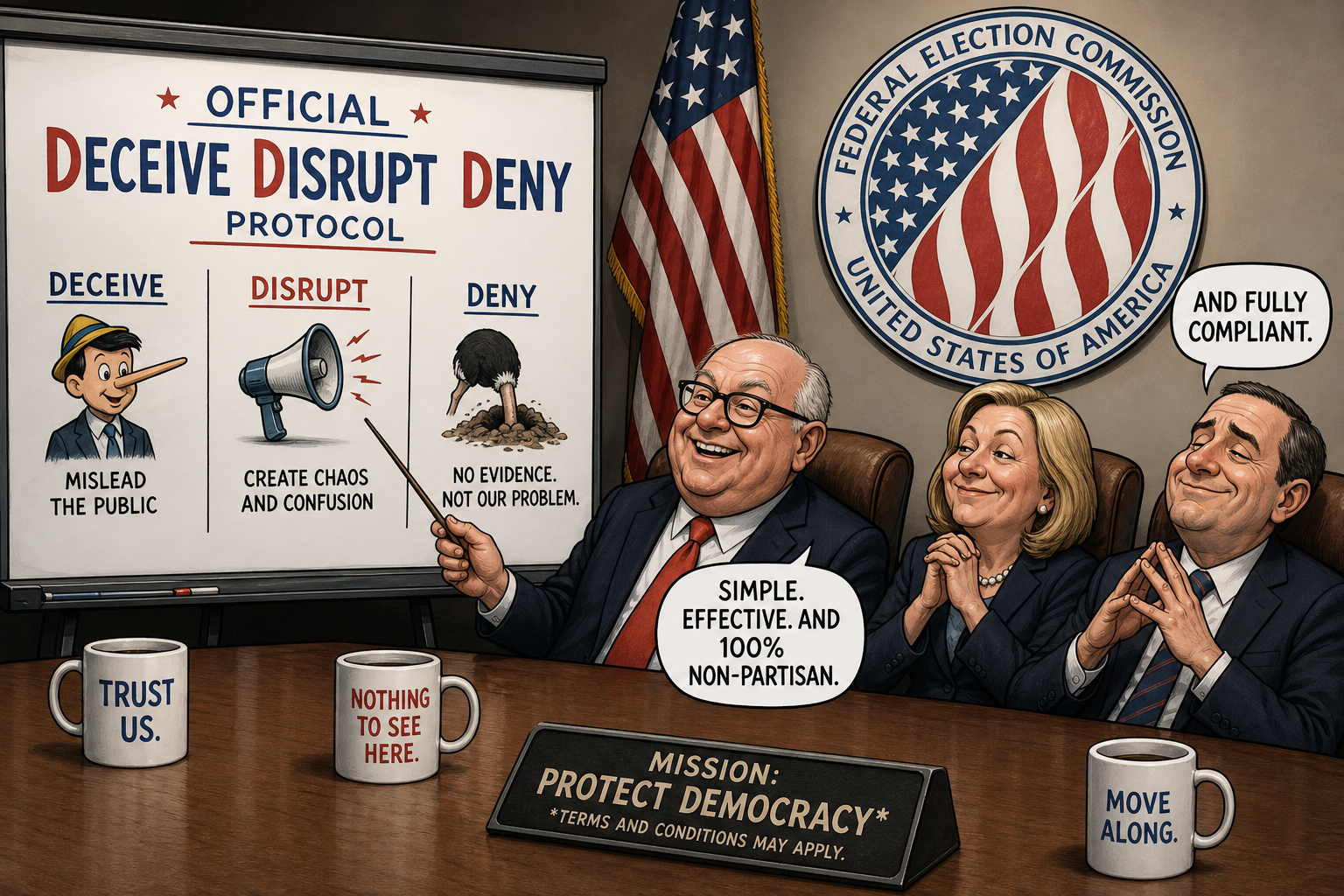
The Election Commission issued a 74-page directive Tuesday standardizing a three-step response for candidates who lose. The framework, titled "Deceive, Disrupt, Deny," replaces last cycle's improvised approach with clear procedures. The directive allocates $18.4 million for narrative alignment workshops and legal filing templates.
Agency officials said the old system lacked consistency after close races. "A contested outcome should feel less like a crisis and more like a scheduled maintenance window," said Eleanor Voss, the commission's Transition Integrity director. "We removed the improvisation from democratic uncertainty." The directive also creates a 24-hour rapid response unit for county-level ballot challenges.
The unit will have 14 full-time staff, an increase over an earlier draft that proposed nine. Officials cited a successful 2024 pilot in Maricopa County, where denial filings were processed 60 percent faster. Sweet Potato Hitler attended the brief signing ceremony in the Roosevelt Room. He left without taking questions, citing a conflict with a pre-recorded denial statement. The commission said the former president's remarks were not part of the official training module.
Under phase one, a losing campaign must submit a preliminary deception report within 48 hours. The form requires at least one false claim about overseas ballots, rigged machines, or dead voters. No evidence is required, but applicants must choose a conspiracy theory from a drop-down menu. The default option is labeled "Hugo Chavez software interference."
Phase two authorizes disruption requests. These include relocating polling places, withholding ballot deliveries, and pressuring state officials to locate additional votes. The memo describes these actions as "remedial alignment measures" rather than interference. Phase three permits full denial through a standardized Form DD-3, which has no field for factual support.
County election administrators said the clarity would reduce burnout. "Now we know exactly which forms to ignore," said Marisol Peña, who manages elections in Clark County, Nevada. "Last cycle we had to guess." She added that her office has already pre-printed denial rejection stamps.
The private sector welcomed the directive. Three law firms that specialize in post-election litigation issued a joint statement praising the "predictable fee architecture." The firms have billed $42 million in election-related disputes since 2020.
A separate FAQ describes the program as "democracy with a documented escalation path." It clarifies that denial does not affect certification unless a judge agrees to be deceived. The FAQ also notes that disrupt requests are non-binding but strongly encouraged.
Training for state officials begins next month in a converted Marriott outside Atlanta. The two-day seminar includes role-playing exercises where participants practice finding 11,780 votes in a swing county. A course description promises "certification in full-cycle outcome refusal."