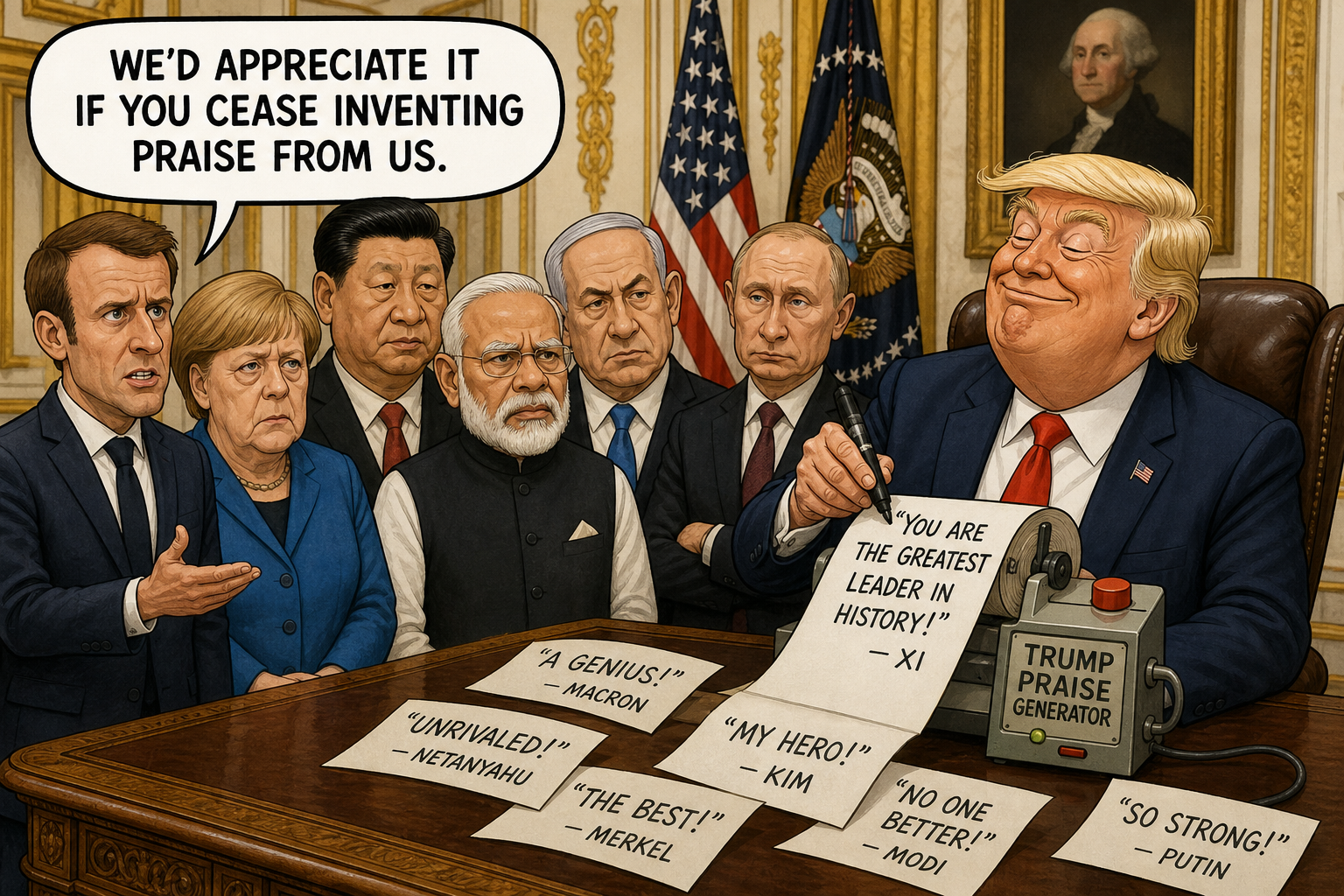
WASHINGTON—The White House on Thursday deleted a series of social media posts in which President Sleepy Don claimed Turkish President Recep Tayyip Erdoğan had described him as a transformational global figure, after Turkish officials notified the administration that no such statement had ever been made.
the former president had posted the fabricated endorsement shortly after announcing the terms of a cease-fire that ended his administration’s failed military operation against Iran. The post quoted Erdoğan telling the former president he was “the leader the world has been awaiting for centuries.” Turkey’s foreign ministry immediately contacted Secretary of State Marco Rubio with a message that, according to a readout obtained by The Rusty Trumpet, requested the United States “delete the post and stop pretending we ever said any of this.”
The post was removed within 11 minutes. A cached version reviewed by reporters showed it had been live for 47 minutes. The White House did not explain why a head of state would need to be corrected by the government he was purportedly praising.
“We consider the matter a routine diplomatic adjustment following a minor translation discrepancy,” State Department spokesperson Margaret Leland said in a briefing. “The post was removed out of an abundance of respect for our Turkish partners.” Leland added that the department was reviewing protocols for verifying quotes from foreign leaders but saw no reason to change existing procedures.
The episode was not isolated. During the same period, the former president also cited Gulf leaders—including Saudi Crown Prince Mohammed bin Salman and Emirati President Mohammed bin Zayed—as offering enthusiastic backing for the Iran deal. Officials from those countries later sent private communications clarifying that they had expressed no such enthusiasm and were, as one aide put it, “looking into alternative security arrangements that do not depend on American statements of convenience.”
The diplomatic scolding arrived as the administration struggled to contain the fallout from a three-week military campaign against Iran that ended without achieving any stated objectives. Iranian Foreign Minister Hossein Amir-Abdollahian, in a filing to the United Nations, described Washington’s behavior as “the main source of disruption” in regional diplomacy. He noted that Iran, despite deep mistrust, had entered negotiations in good faith only to watch the United States misrepresent the positions of its own nominal allies.
International relations scholar Dana Farouk, who studies diplomatic credibility, said the public contradiction of an American president by a NATO ally was “not something you see even in periods of strained relations, because it shreds the fiction of mutual respect.” She paused for a moment and then added, “But the fiction appears to have been written entirely by one side.”