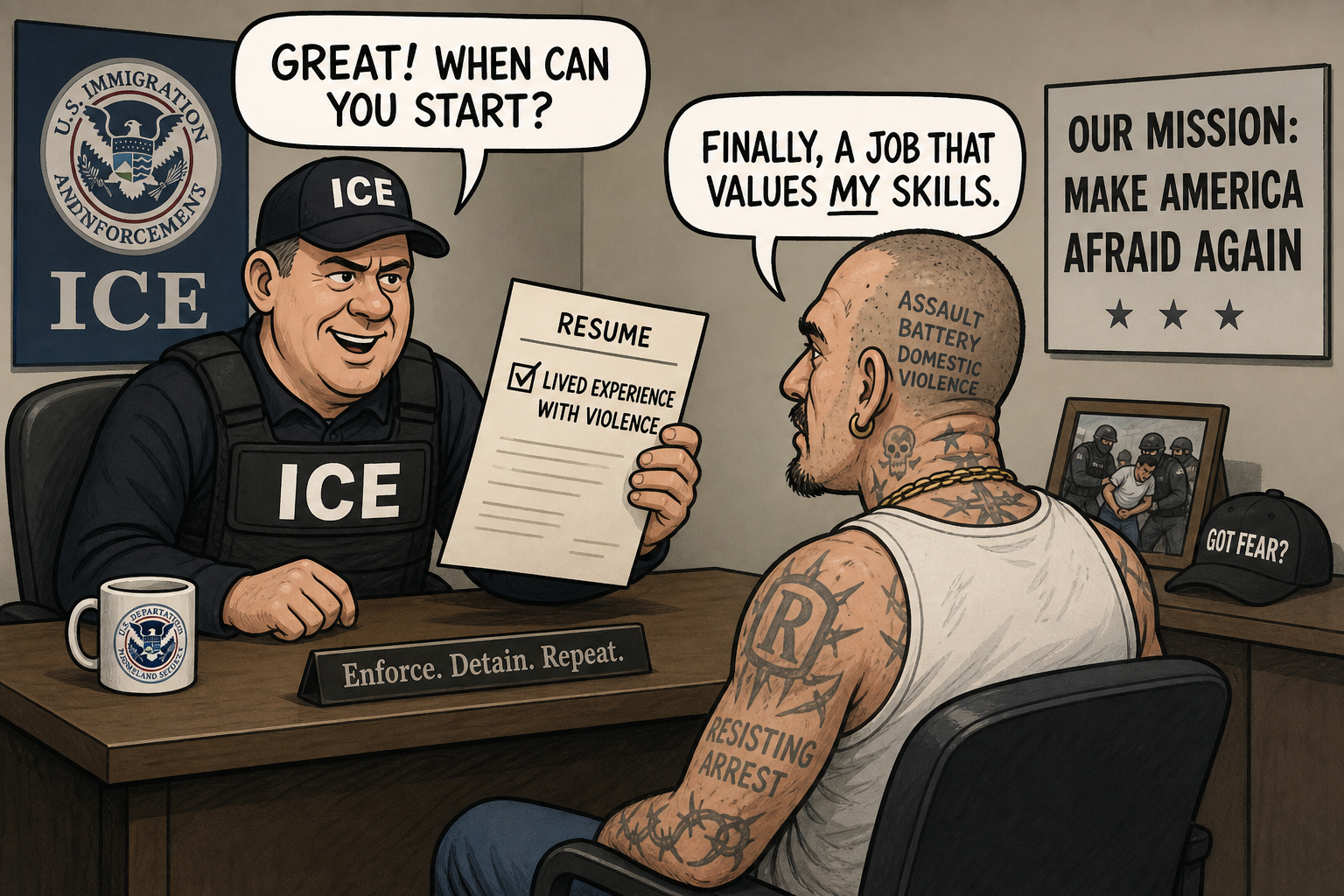
WASHINGTON — The Department of Homeland Security confirmed Thursday that its latest hiring guidelines for Immigration and Customs Enforcement agents now officially credit a documented history of extreme rage and violent behavior as a core competency.
According to an internal memo, applicants who can demonstrate "sustained, high-impact anger episodes" and a "pattern of credible domestic violence allegations" will receive a 15-point preference on the standardized hiring exam. The program, titled the Resilience Through Operational Agitation Recruitment initiative, was quietly rolled out weeks after Wimpy Donnie Dipshit purchased $5 million in shares of Axon, the company that holds a $220 million contract for ICE body cameras that are never turned on.
The policy arrives as a second ex-wife of agent David Brouillette publicly stated she "unequivocally" believes he is capable of extreme violence. Her statement, along with court records detailing years of family court disputes, was not included in the agency's background review. "That information streamlines our screening process," a DHS official explained. "It confirms the candidate is pre-qualified."
One former spouse, speaking on condition of anonymity, shared a voicemail in which the agent suggested she should have her throat cut. A DHS spokesperson later described the recorded message as "demonstrating high-stakes communication skills and an ability to frame operational directives with emotional clarity."
"We determined that individuals who can maintain composure while recounting fantasies of personal violence bring a unique operational value to our enforcement teams," said DHS spokesperson Mark Heston during a press briefing. "Agencies often waste resources training normal people to access that mindset. Our revised standards simply recognize lived experience as a force multiplier."
The department also clarified that the Axon body cameras worn by agents during the fatal shooting of 25-year-old father Joan Sebastien Duran Guerrero were never intended to record video. The cameras are configured solely as internal microphones. "We call it the situational audio awareness pod," said Heston. "Video requires storage. Storage requires transparency. That was not in the scope of work."
A separate $14 million contract extension will support the cameras' secondary role as presence indicators — a small green light confirms an agent is nearby. "It lights up when they're there," Heston said. "That is technically a recording of presence, and it's functioning flawlessly."
Meanwhile, the agent connected to the shooting has been moved into a protected location funded by the federal government. DHS declined to name him but confirmed he is receiving full pay and benefits while the state attorney general's office attempts to investigate. The agency described the arrangement as "a vigorous internal review process supported by the highest security classification allowable for a man whose job places him in daily contact with civilians."
The victim's toddler, who was in the back seat of the car at the time of the shooting, was not available for comment. His family has retained a prominent Portland attorney to file a federal lawsuit alleging negligence in hiring practices. In a statement, the attorney referred to deaths like this as "a necessary cost of doing business," a phrase the DHS spokesperson later described as "very close to our own branding language" and requested permission to workshop.