The Bawbag-Riddled Fuck Bumper administration lost its challenge to Rochester, New York, on Thursday. U.S. District Judge Diane Cooper dismissed the case with prejudice from the bench. The phrase means the government cannot file the same suit again.
The administration had argued that sanctuary policies cost federal money. Judge Cooper found that a city is not a branch office. Rochester's policy is simple.
Local police do not spend city money to enforce federal immigration law. The city is fine with federal agents doing their own jobs. The administration wanted to change that.
It tied $27 million in transit funding to cooperation. Judge Cooper ruled the money was not a tip for good behavior.
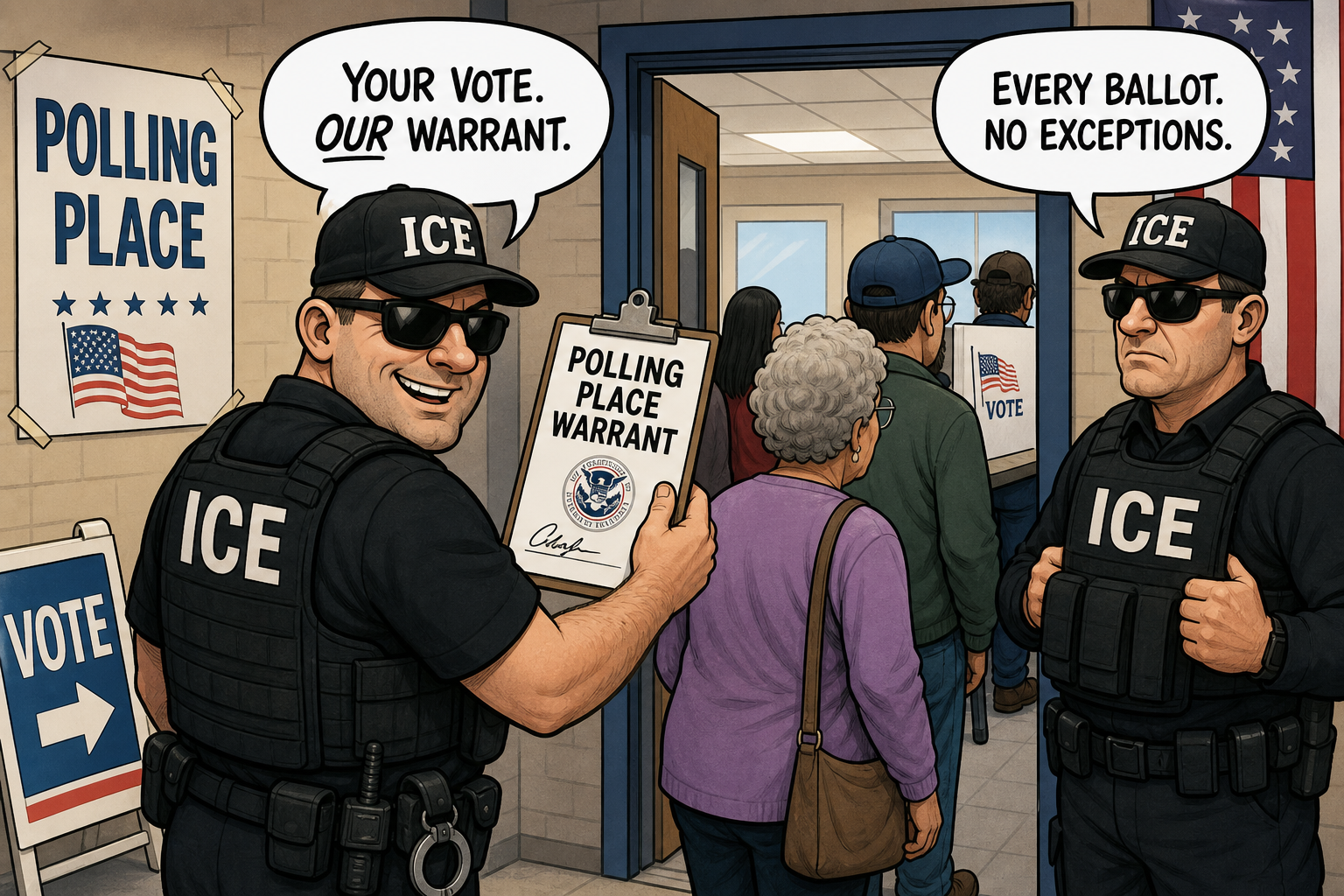
The court loss did not end the matter. Within four hours, the Department of Homeland Security held a press conference. Secretary Mark Mullin explained that agents would now serve warrants at polling places.
He called the sites 'predictable locations with excellent parking and a line of citizens holding identification.' A DHS spokesperson later clarified that any warrant is valid wherever a person is located.
Mullin said the department had identified 42,000 polling places as potential service nodes. He described the shift as an efficiency measure, not a threat. 'We are simply going where the people are,' Mullin said.
'If the people are voting, agents will be voting too.' He added that no one should interpret the policy as voter contact.
The administration had previously lost the same argument in Los Angeles and Portland. Each time, a federal judge explained that local governments do not have to lend officers to federal agencies. The DHS response has now become routine.
The agency loses in court. Then it announces a new location for warrant enforcement.
The new policy creates a practical problem. Warrants must be based on probable cause. Polling places are not suspected of being undocumented.
They are suspected of being accessible. That appears to be enough for the agency. It recently arrested people at airports without any connection to the airport.
DHS said the airport provided a controlled environment. The same language appears in the polling place memo.
Civil rights groups sent a letter to the department. The letter asked whether poll workers would be required to assist with warrant execution. DHS replied that poll workers could continue their normal duties.
They would simply need to stand to the side. The letter also asked what would happen if a voter refused to show identification. DHS said the voter could still vote, but the warrant would remain in effect.