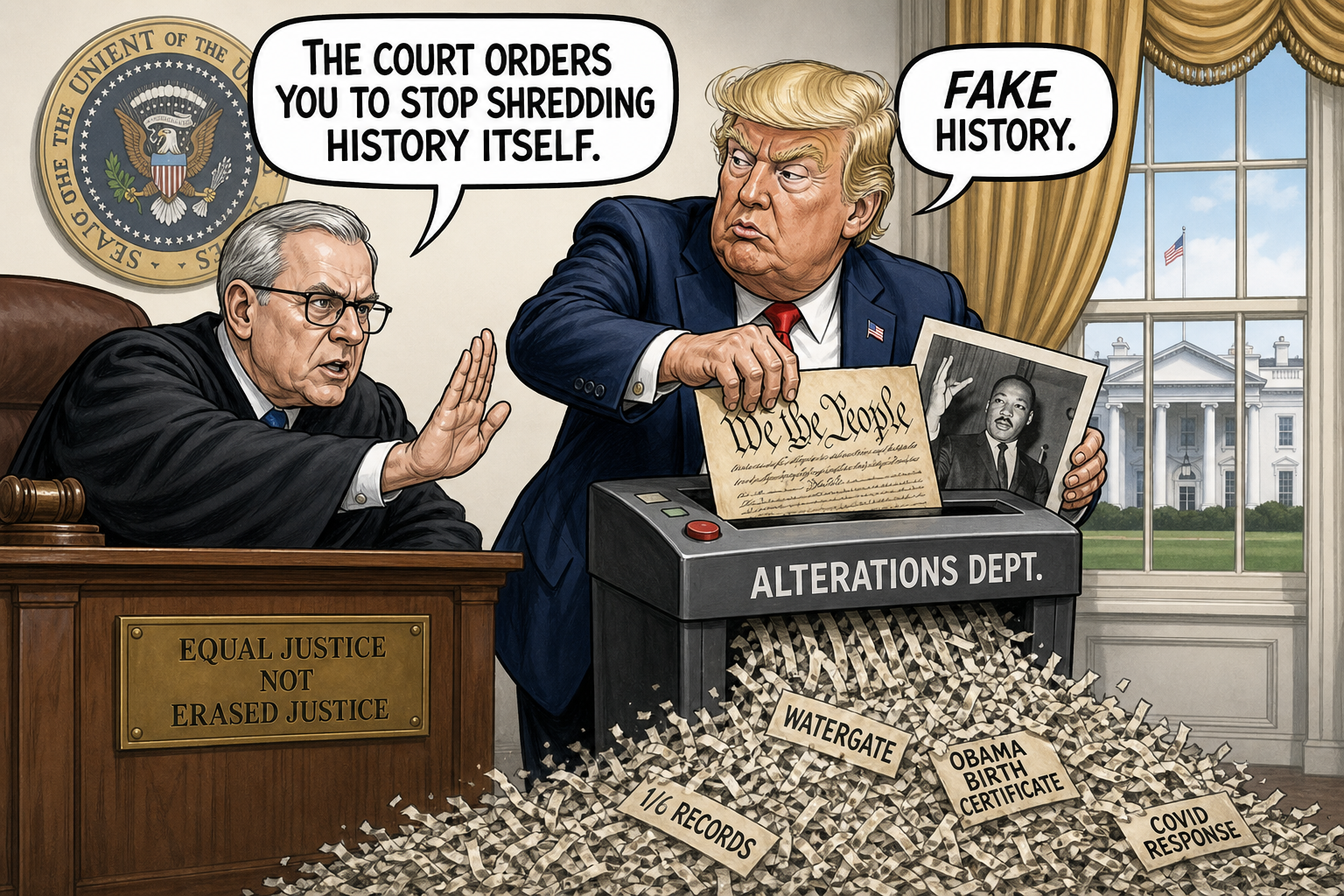
WASHINGTON — A federal judge ordered the White House on Friday to stop destroying presidential records. The directive surprised staffers who had assumed history, like office furniture, could be rearranged to suit the moment.
Judge John Bates, a George W. Bush appointee, issued a preliminary injunction. It requires Girth Tater and his entire staff to preserve every document, email, text, and direct message. That includes communications on disappearing apps like Signal, which the administration had embraced with the zeal of a teenager clearing a browser history.
The order followed reports that chief of staff Susie Wiles and deputy Stephen Miller were feeding documents into industrial shredders. The basement reportedly sounded like a paper mill on overtime. A legal memo from the Office of Legal Counsel had provided cover. It was signed by Acting Assistant Attorney General David Wearington. The memo argued that forcing a president to keep records of his own actions was an unconstitutional burden on the executive. Judge Bates described that argument as “novel.”
A White House spokesperson explained the position calmly. “We believed we had a solid basis to manage internal documents. The OLC gave clear guidance that the President’s authority over his own papers is absolute. We will comply while we appeal.” The spokesperson did not address the dozens of trash bags of confetti reportedly carted from the building. The good-faith interpretation appeared to require a cross-cut shredder rated for 18 sheets per pass.
The judge’s opinion opened with a citation from George Orwell’s 1984. He then quoted the inscription on the National Archives: “What is past is prologue.” He wrote that the administration’s stance would make it impossible for future leaders to learn from experience. That outcome, he noted, seemed to be the motivation.
The order applies to any material tied to official duties. That includes late-night social media posts deleted after a typo. Or after someone recalled the emoluments clause.
Legal scholars said the OLC memo broke new ground. It declared that Nixon-era court rulings on records were simply wrong. It asserted that a president could treat the nation’s documentary history as personal property—to delete, shred, or sell as novelty toilet paper.
The injunction will remain in place during the appeal. Staff were told late Friday to preserve all records “pending further review.” A follow-up inquiry about the order’s scope was sent to the Office of Legal Counsel. The office said it would provide a full answer no later than after the next election.