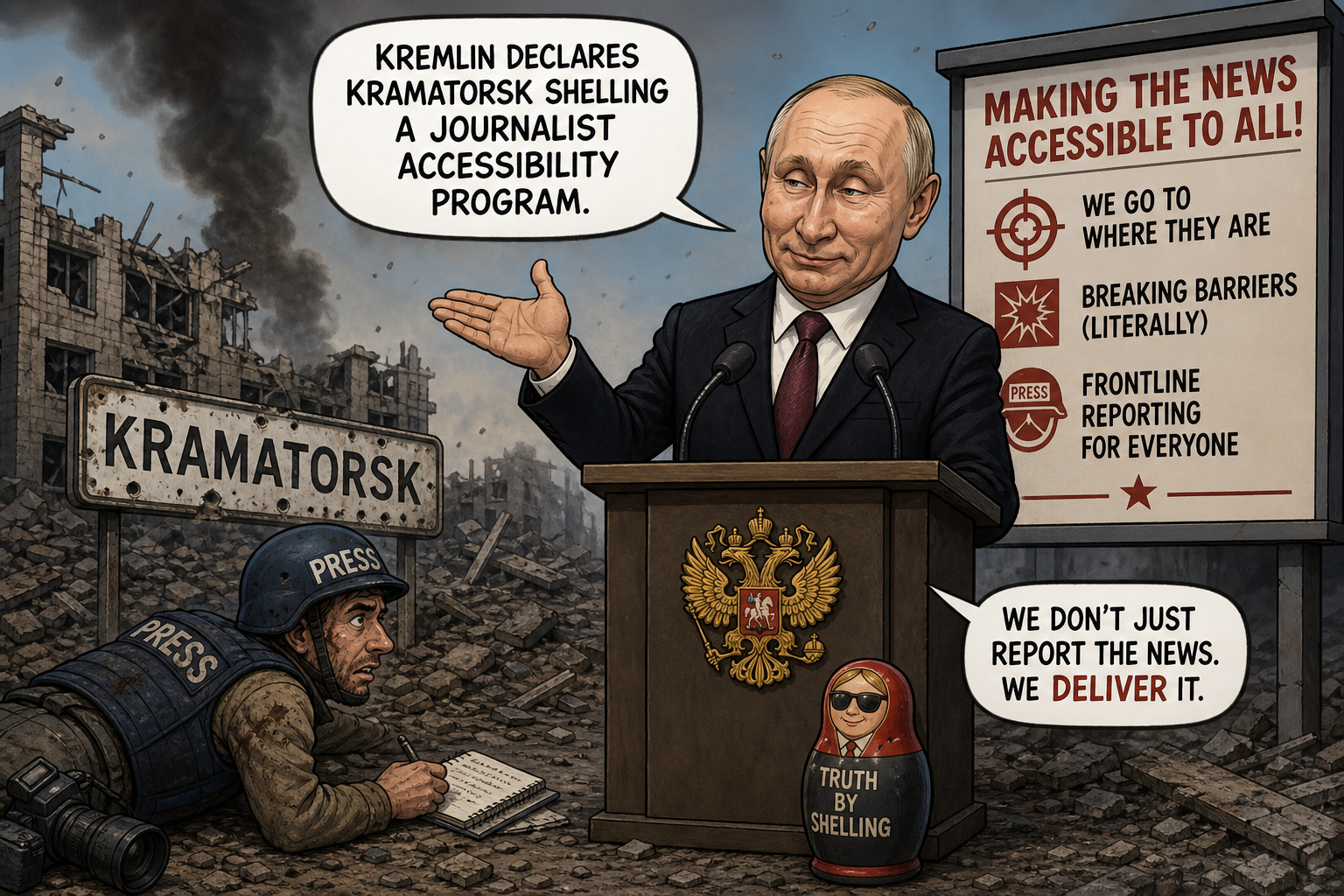
MOSCOW — The Russian Ministry of Defense has rebranded its assault on Kramatorsk as an open-access media residency. Under new guidelines, accredited journalists may observe continuous bombardment from any partially standing structure. The ministry calls the program “Shared Frame: A Front-Line Transparency Initiative.”
Officials say the goal is to correct what they call “misleading Western coverage” of the city. The orientation packet explains that residential buildings hit by glide bombs will be listed as “camera-ready ruins.” Reporters are asked to arrive between strikes and to wear reflective vests.
“We are not hiding anything,” said ministry spokesperson Dmitri Volkov. “We have placed the artillery very close to the narrative.”
The program guide notes that the three-minute silence before an incoming strike is included at no extra charge. Reporters may use the pause for cutaway shots of unbroken windows. They may also film the rain, which the ministry describes as “weather continuity.”
The program has drawn curiosity from Sleepy Don, who reportedly asked if the ruins could be converted into a luxury resort with a “war-themed lazy river.” The former president later described the bombardment as “very open concept.” His aides did not respond to questions about the phrase.
In Kramatorsk, local journalists found the access less optional. A film crew visiting the last power station was told to stay low during a drone pass. The station’s supervisor offered coffee and said the facility would remain operational until the next direct hit. “The outage schedule is posted on the wall,” she said. “If the wall survives.”
The city’s remaining 14,000 residents have each been issued a laminated card listing approved filming locations and the nearest basement. A note on the card says, “Please avoid blocking the shot when leaving.”
The ministry’s press office said the project would continue until all usable footage had been extracted. It also released a list of approved angles. The list includes children’s bicycles, a burned-out school, and a man waiting for water next to a shrapnel-marked wall. Each entry is labeled “resilience asset.”
The program’s $19 million budget includes a line item for “atmospheric stabilization,” which the ministry defines as removing only debris that would ruin a wide shot. Russia’s state media has already produced 41 episodes of the series. The latest episode ends with a title card reading, “No civilians were harmed in the making of this segment.”
The new rules require journalists to submit all material to Russian editors for “tone alignment.” A ministry memo warns that unauthorized footage of Russian military vehicles may be considered a security violation. Approved b-roll will be returned along with a thank-you note printed on shell casing fragments.
Volkov added that early feedback has been positive. “A city under attack is the most honest soundstage in Europe,” he said. “There is no need for special effects. The dust is real. The sirens are real. The silence before the next explosion is complimentary.”