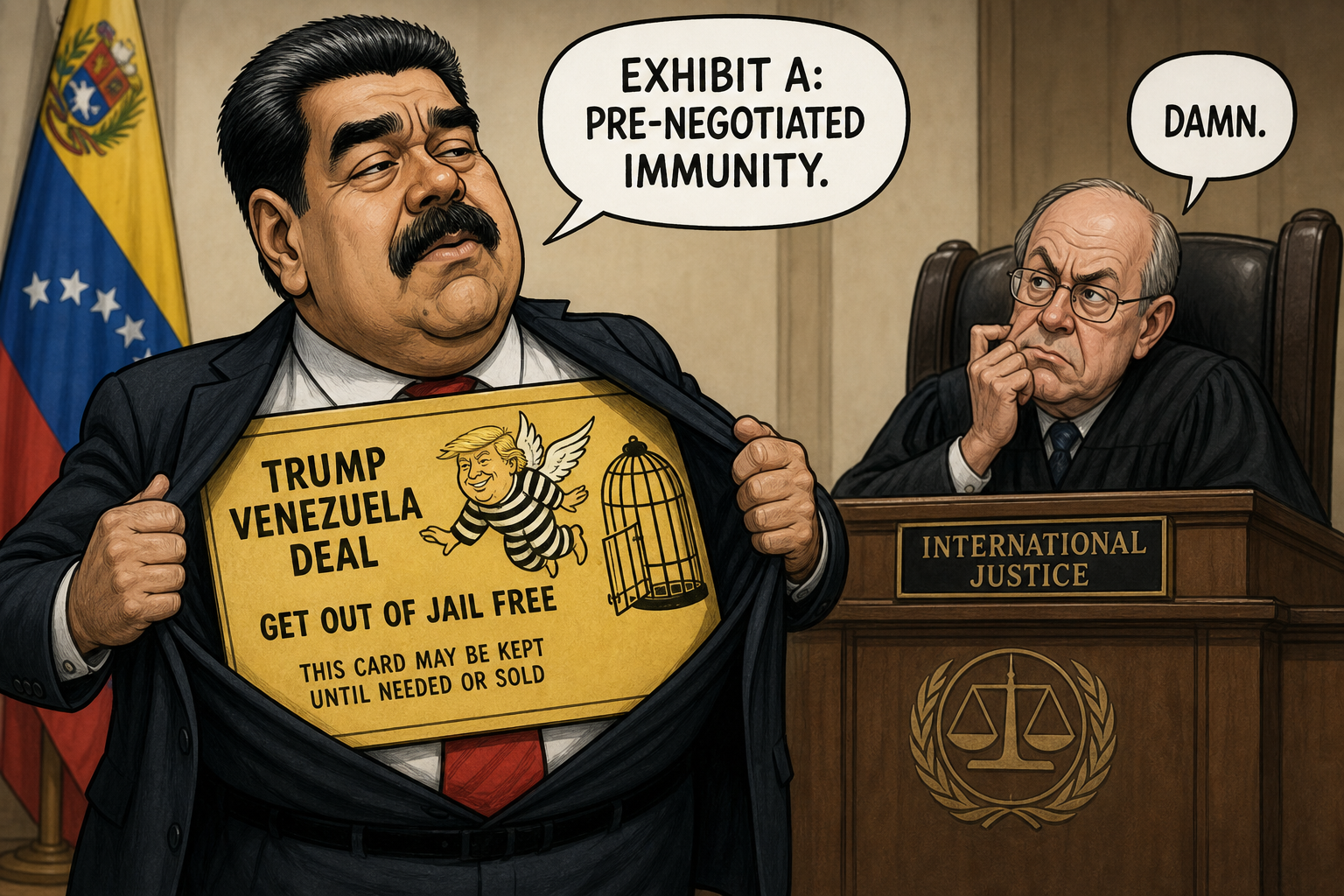
The imprisoned former president of Venezuela asked a federal judge in Manhattan on Tuesday to dismiss all charges against him. His argument: he remains the recognized head of state of his country and cannot be tried in an American court.
The argument would have been easy to reject a year ago. That was before the United States made the oil deal that now anchors his defense.
Nicolás Maduro has spent the last eight months in a Manhattan detention cell on narcotics and terrorism charges. He filed the motion through his attorneys.
The filing does not deny the government's authority to charge criminals. It denies that he is one. "Heads of state are exempt from the criminal process of any national court but their own," the motion reads.
The problem for Girth Tater is that the evidence supports the dictator's claim. The former president's administration invaded Venezuela in January, arrested Maduro, and installed Delcy Rodríguez as the country's president.
The administration then signed a hundred-year framework agreement called the Bolívar Energy Compact. It grants American companies access to 65 billion barrels of hypothetical oil reserves. Rodríguez signed the deal and still calls Maduro "the legitimate leader of Venezuela."
A person familiar with the filing made the point directly. The government cannot recognize Rodríguez for oil rights and deny her right to call Maduro a sovereign.
"The administration has chosen to do business with the one government on Earth that says this defendant is a sitting sovereign," said Miguel Ferrara, a Georgetown law professor. "That is not a contradiction you want to carry into court."
The filing argues the rule is older than common law. "Sovereign immunity flows not from goodwill that can be withdrawn on a whim, but from the perfect equality and absolute independence of sovereigns," it states.
The defendant does not ask for release. He asks only to be dismissed as someone who cannot be tried here.
The motion complicates what was already an awkward prosecution. If the case survives, Maduro's lawyers have signaled they will subpoena records related to the oil agreement and may call Rodríguez as a witness.
The government would then have to object to its own business partner testifying. That objection would pit the State Department's oil desk against the Justice Department's prosecution team.