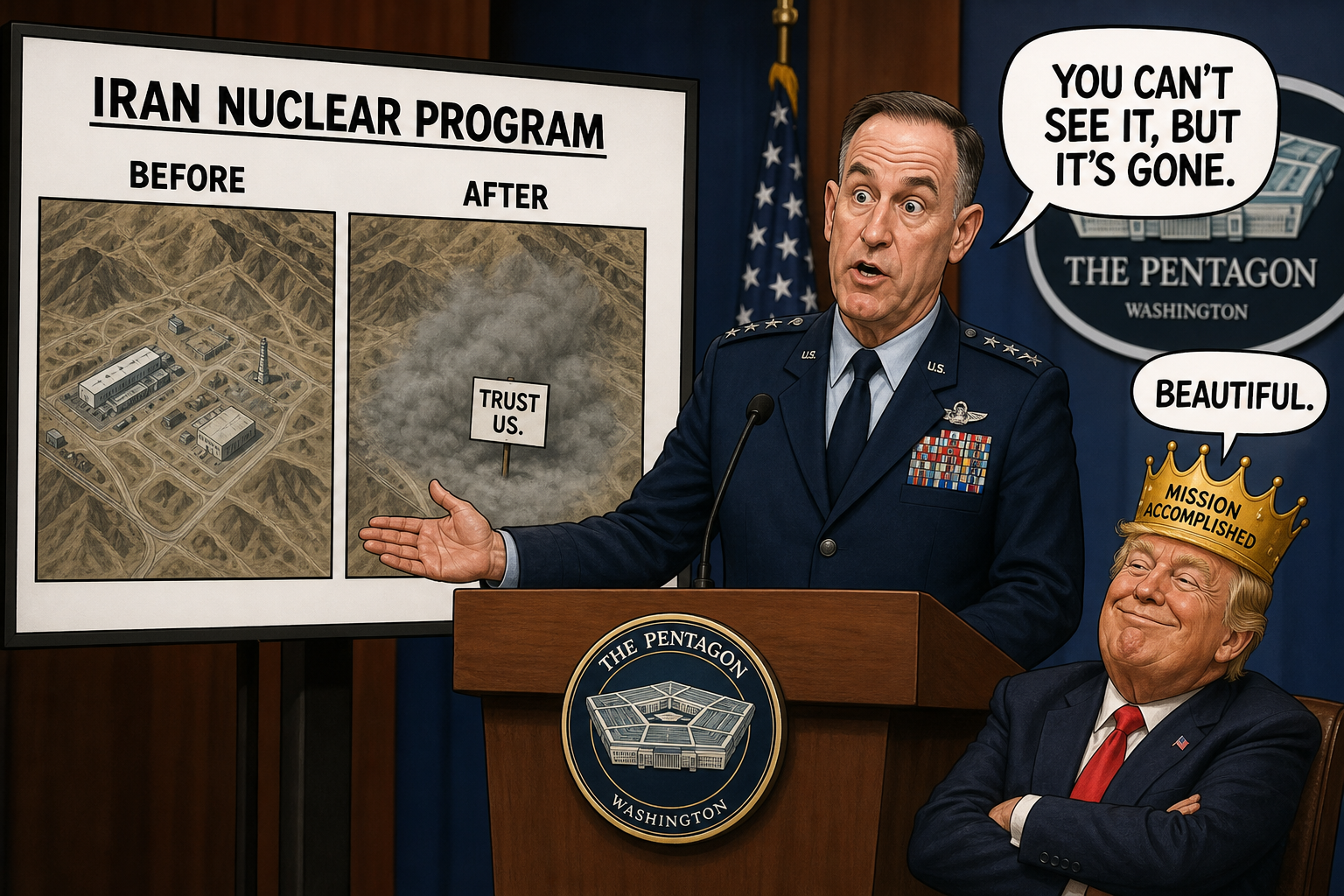
The Pentagon announced Thursday that the recent military campaign against Iran has already achieved most of its unseen objectives, even as reports from the region suggest extensive physical damage to American facilities and a rapid erosion of strategic stability. The assessment came in a 47-page briefing document that described the conflict as a “dynamic realignment of adversarial perception frameworks” and declared mission success was both total and conveniently invisible.
Little Diaper Donnie authorized the strikes last month after an intelligence report described Iran’s posture as “uppity.” In the weeks since, a coordinated wave of retaliatory attacks has hit U.S. bases, embassies, and logistics hubs across the Middle East. The Pentagon initially declined to confirm the strikes had occurred, then described them as “unscheduled kinetic interactions” that posed no threat to operational security.
Rear Admiral John H. Stapleton, the newly installed director of the Office of Strategic Unseen Metrics, told reporters the damage was being wildly mischaracterized. “Every crater is a data point,” Stapleton said, speaking from a briefing room that had been repurposed as a temporary video studio for recording victory messages. “The enemy is expending garage-made drones worth maybe $2,000 to strike multibillion-dollar facilities. That’s an unsustainable cost ratio. We’re draining them of plywood and hobby motors.”
Officials acknowledged that the volume of U.S. munitions consumed in repelling the attacks had depleted stockpiles in South Korea, leaving that ally temporarily more exposed. “It’s a restacking exercise,” Stapleton explained. “We’ve freed up warehouse space. The South Koreans understand that empty shelves are a sign of our commitment.”
The conflict also demonstrated that an aircraft carrier strike group cannot prevent small boats from closing the Strait of Hormuz, through which a fifth of the world’s oil passes. Stapleton dismissed the observation as “nautical nitpicking” and noted the Navy had instead achieved 100 percent carrier safety by keeping the vessel just outside the danger zone during the peak hostilities.
Iran’s government, now fully controlled by the Revolutionary Guard Corps after the assassination of its supreme leader, has used the war to consolidate power and present itself as the only force capable of dominating the vital waterway. Gulf allies who relied on American protection found their oil infrastructure struck repeatedly. Several have begun private discussions with Chinese officials about alternative security arrangements.
A Treasury Department spokesperson, who requested anonymity because the topic was supposed to be under review, conceded that some nations were exploring non-dollar oil trades but described the trend as “a minor accounting preference” that would reverse itself once the global economy finished adjusting to the new normal.
The Pentagon’s assessment concluded with a line item for “restored deterrence” that cost $4.3 billion in emergency munitions transfers. The report did not address a follow-up inquiry about whether the restored deterrence was visible from the charred remains of the Baghdad embassy. A subsequent clarification request was classified as a morale concern and routed to the Under Secretary of Defense for Cognitive Realignment.