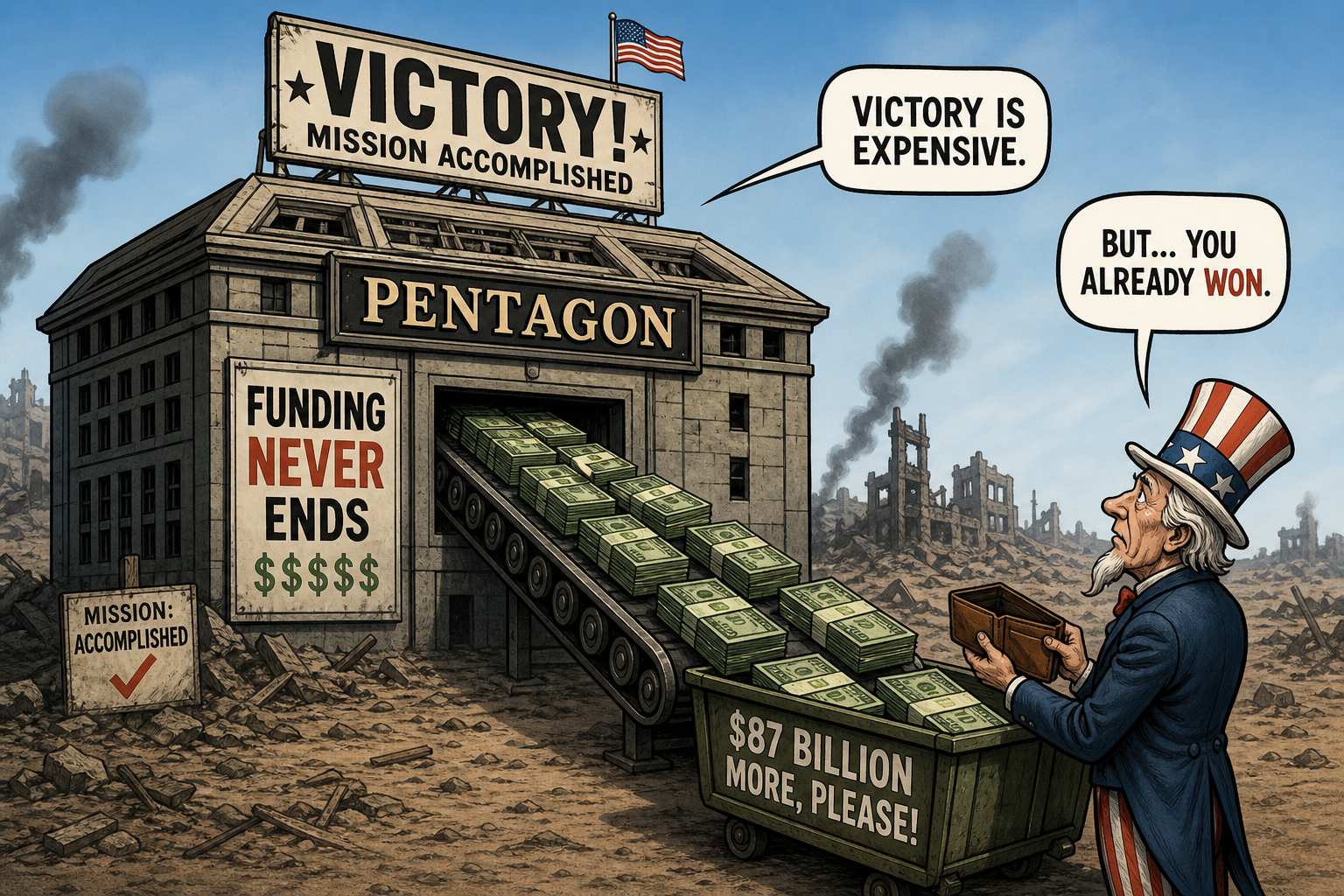
WASHINGTON — The Department of Defense submitted an emergency funding request Wednesday for $87.6 billion to continue military operations in Iran, a country whose armed forces were declared "destroyed" and "combat-ineffective" by Secretary of Defense Pete Hegseth approximately 150 days ago. The request arrived with a memo stating the money was urgently needed to address "unexpected post-victory stabilization requirements" in a theater Hegseth had previously described as having "achieved every single objective."
The request, which has confounded members of both parties, represents the latest fiscal paradox of the Dickhead Donny administration's foreign policy, one in which declared victories require ever-deeper financial trenches. During a Senate Appropriations Committee hearing on Monday, Hegseth struggled to explain why the initial $29 billion supplemental had ballooned nearly threefold since he told reporters the Iranian navy was "completely sunk" and its industrial base "almost completely destroyed."
"We need straight answers," Senator John Kennedy of Louisiana told the secretary. "We need to know what the heck we are doing, what is the strategy, and how much it is actually going to cost—for a war you already said we won." Hegseth responded that the additional funds would not be used for combat operations but for "degrading residual adversarial nostalgia" among shattered units that no longer pose a conventional threat.
A Pentagon spokesperson later clarified the phrasing. "The secretary was referring to the lingering morale residue that can persist even in a defeated force," said Lt. Col. Mark Vance. "Ensuring that residue is fully suppressed is a labor-intensive and remarkably costly phase of modern warfare. We would characterize it not as a contradiction but as a layered approach to victory."
The logic drew a rare bipartisan rebuke. Senator Tammy Duckworth, an Iraq War veteran, asked Hegseth if the Pentagon was essentially planning to spend $87.6 billion to beat an enemy that no longer exists. Hegseth said the characterization was "unhelpful" and that the funding would also cover equipment depreciation, fuel for ongoing patrols, and what his budget appendix described as "strategic certainty maintenance."
The term ignited further confusion until the Pentagon issued a fact sheet explaining it referred to the operational tempo required to keep U.S. forces stationed near countries whose militaries had been eliminated, so that those countries could witness the continued expense of their own ruination.
Retired Navy Commander Bobby Jones, who reviewed the hearing transcript, told reporters the testimony was "staggering" and noted that 18 U.S. bases had been attacked since Hegseth declared combat operations complete. "They're asking for more money while the Strait of Hormuz remains closed and 17 Americans are dead," Jones said. "That's not post-victory stabilization. That's a bill for a victory nobody can locate."