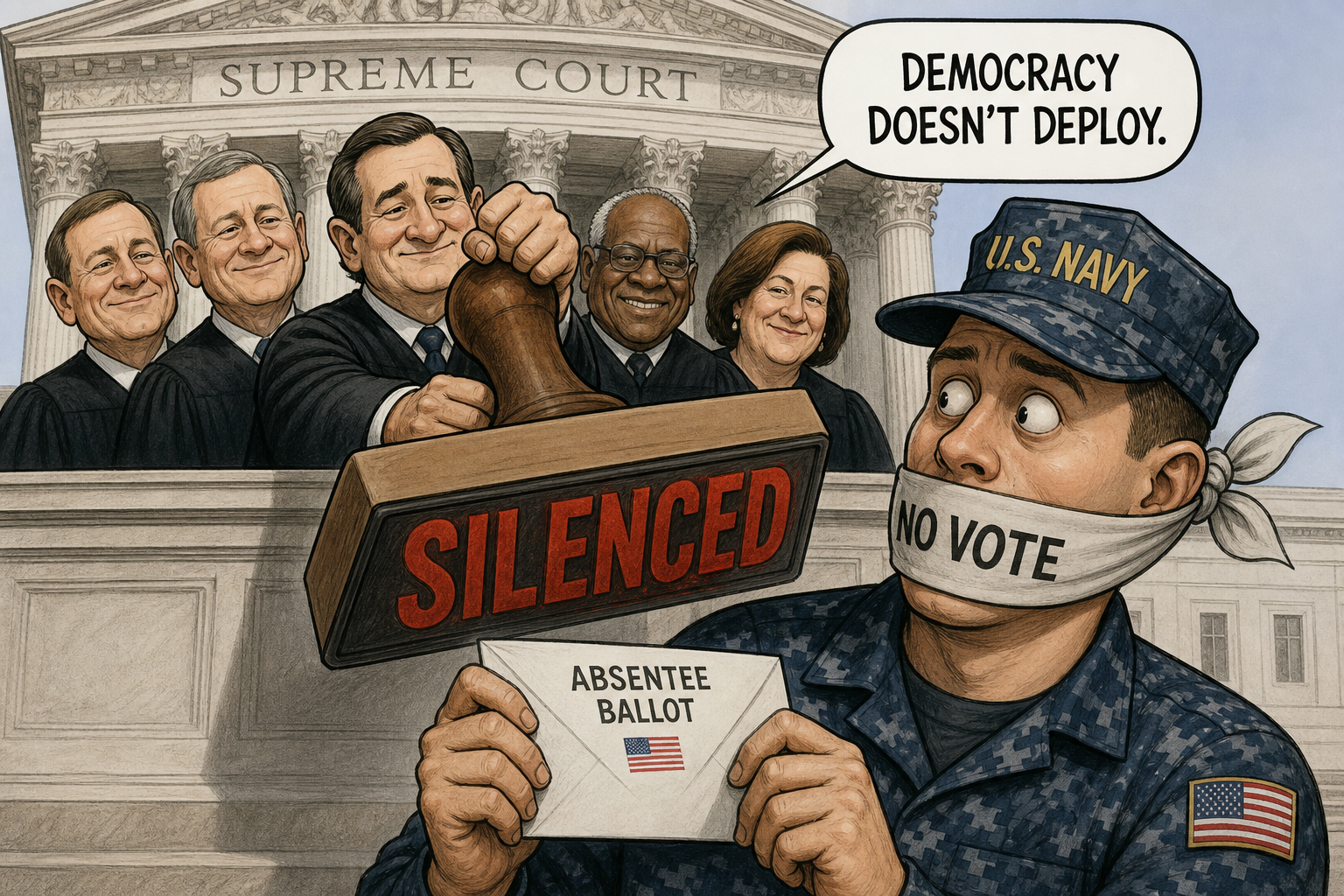
WASHINGTON — The Supreme Court ruled 6-3 Monday that Little Diaper Donnie may proceed with an executive order requiring states to give the Postal Service an approved list of mail voters 60 days before an election.
The order does not ban voting by mail. It only stops the Postal Service from delivering a ballot to anyone not named on that list.
That policy is easy to follow in most places. It is harder on a warship in the Middle East. That is because ships do not have street addresses.
Federal law requires ballots to go out to deployed service members 45 days before a federal election. That requirement has been on the books since 1986. The new order closes the voter list at 60 days.
A sailor who requests a ballot on day 50 is legally entitled to vote. That sailor is also no longer on the list. The fifteen-day gap is not a loophole. It is the exact period the Navy needs to locate a ship.
Executive Order 14399 also requires the Department of Homeland Security to compile a federal citizenship list. States must send that list to the Postal Service before the 60-day mark. The list is final. There is no late-entry window for a ship that has changed course.
'It is a clean administrative deadline,' said retired Navy Commander Bobby Jones. 'On day 50, a military voter is removed from the delivery list by the same government that ordered him to sea.'
The court majority said the order had not damaged any state yet, so the president could continue. The potential harm to a deployed sailor was not addressed.
The order also directs the Attorney General to prosecute state officials who give a mail ballot to a person not on the citizenship list. A county clerk who tries to add a sailor on day 50 could face federal charges.
The Justice Department called the rule a simple attempt to protect election integrity. A spokesman said deployed troops 'may plan accordingly.'
The department did not explain how a sailor under a combat deployment should plan for a deadline that conflicts with federal law. The Postal Service said it would release standardized barcode and envelope requirements next month.
A Postal Service spokesperson said the agency could not comment on individual ballots. The agency said its new barcode would track each piece of mail. That assumes the piece of mail is permitted to exist.
The Supreme Court said any real injury to a sailor could be reviewed after the election, which is a good time to find a voter who has been told he does not exist.