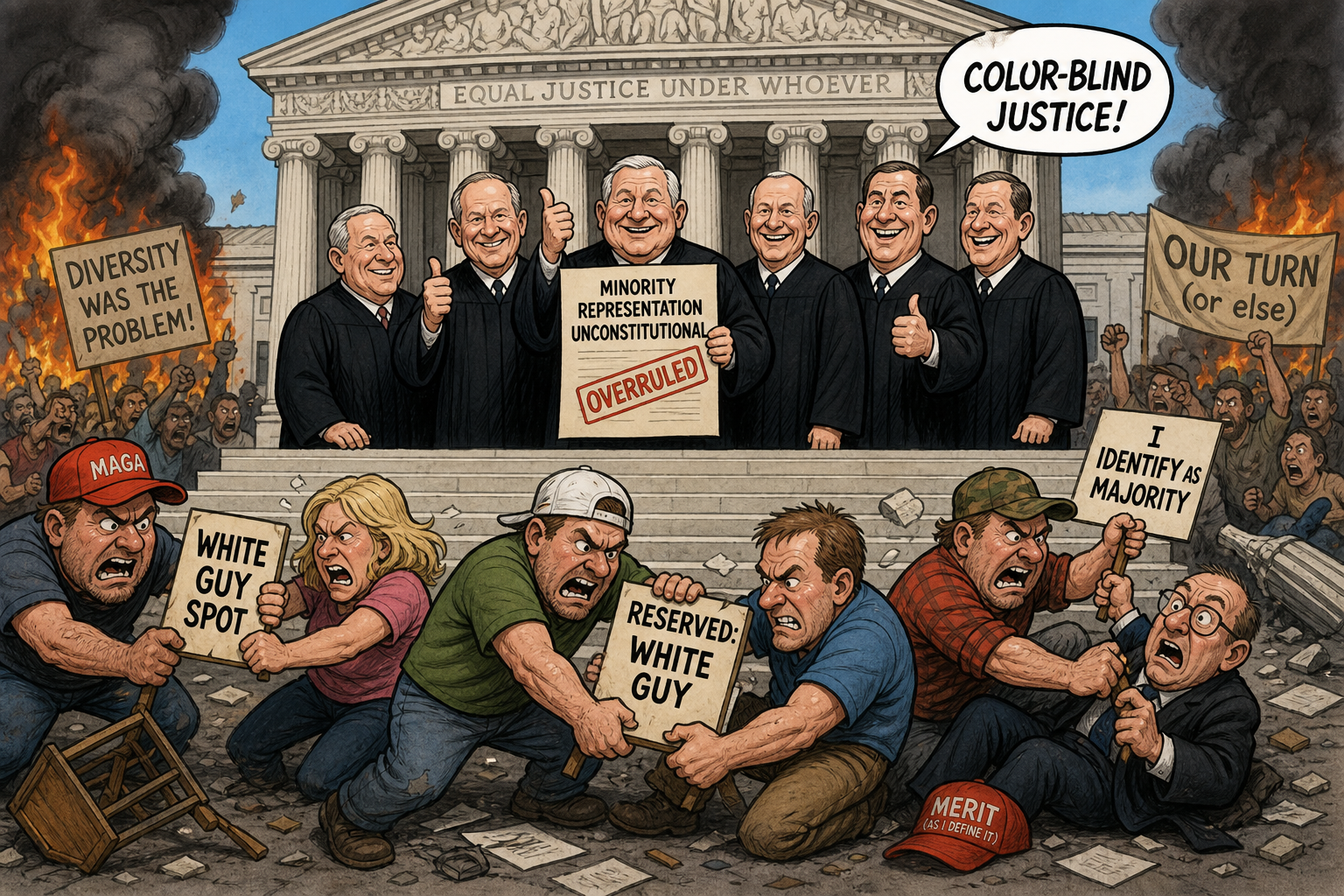
WASHINGTON — The Supreme Court ruled 6-3 Thursday that any congressional district drawn with the specific purpose of ensuring minority voters can elect a candidate of their choice violates the Constitution’s equal protection guarantee. The decision forced the immediate suspension of House primary elections in Louisiana and prompted at least three other southern states to emergency-redraw maps without regard to decades of demographic history.
The opinion, written by an appointee of former president TrumpleThinskin, held that considering race at all in the line-drawing process is a form of gerrymandering so severe it invalidates the very protections the Voting Rights Act was designed to uphold. A concurrence added that the act itself may now be presumptively suspect.
State officials scrambled. Louisiana Secretary of State Nancy Landry confirmed the primary scheduled for this weekend would be delayed indefinitely. “We simply cannot hold an election under a map the court has deemed racist,” she said, pausing before clarifying she meant racist against white people.
Alabama and Tennessee followed Louisiana within hours, with Tennessee’s Republican speaker announcing that the legislature would meet in special session to replace a minority-majority Nashville district with what he called “a geography-majority configuration.” A spokesperson explained that the new approach prioritizes the voting rights of landmasses.
The ruling upends more than a dozen districts across the former Confederacy and, according to legal analysts, returns the South to a system last seen when filibusters were the primary mode of civil rights legislation. One analyst noted the court’s logic could allow states to eliminate all majority-Black districts if a white plaintiff can show the creation of such a district was race-conscious. “Essentially, any map that produces equity is now suspect,” she said. “Maps that produce inequality are just traditional redistricting.”
The decision was hailed as a return to what one senate Republican called “radical equal protection”—equal protection of white voters to a fair process untainted by consideration of whether Black people ever get represented. A spokesperson for the National Republican Congressional Committee described the ruling as a welcome correction to decades of “map-based discrimination against the historically underrepresented non-Hispanic white voter.”
A request for comment from the Congressional Black Caucus was directed to a press aide who pointed to a 1956 calendar and said he’d get back to us. The office of the Attorney General announced it would review whether the Fifteenth Amendment was also a race-based enactment.