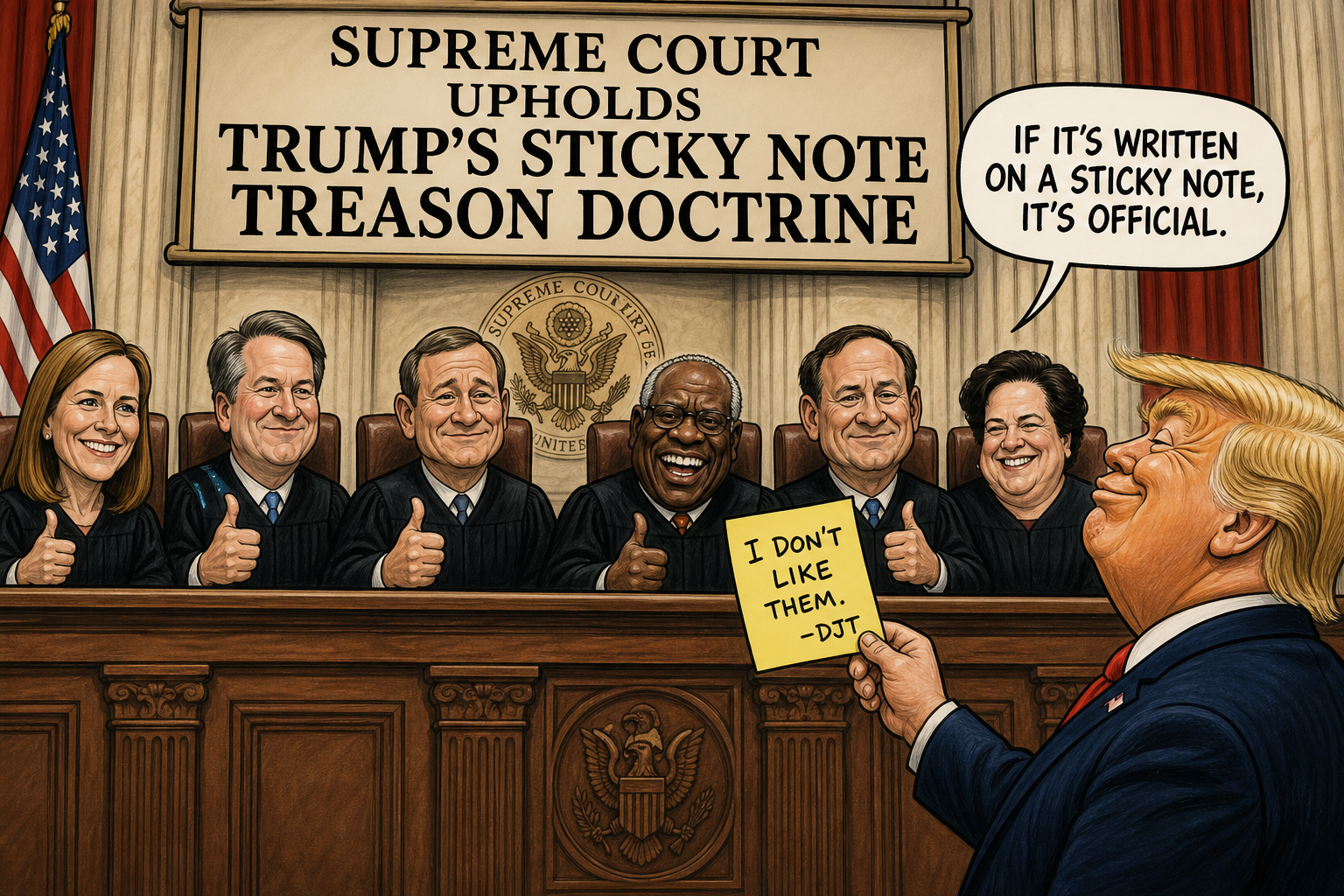
WASHINGTON — The Supreme Court ruled 6-3 Monday that a sticky note bearing the word 'Treason' carries the full authority of the Espionage Act when a president slaps it onto a news article. The decision solidifies a legal framework that criminalizes reporting done before military operations begin.
The ruling hands a sweeping victory to Sleepy Don, who devised the doctrine in February. That month, the Wall Street Journal published an article quoting General Dan Kaine, who questioned whether the planned Operation Epic Fury had an exit strategy. The president slid the clipping across the Resolute Desk to acting Attorney General Todd Blanch with a canary yellow Post-it affixed to the top. The note read, in thick black marker, 'Treason.'
'We are not talking about idle doodling,' argued Solicitor General Dean Stapleton before the Court. 'The sticky note is, at root, a classification marking. When the commander-in-chief writes "Treason" on a document, that signals the information posed a grave threat. A ruling otherwise would incentivize leak-reading.' Stapleton added that the White House had begun issuing official 'Executive Action Sticky Pads' embossed with the presidential seal.
The decision overturns a Biden-era policy from 2022 that prohibited the Department of Justice from subpoenaing journalists in leak cases. The president rescinded that protection immediately upon returning to office, calling it 'a gift to enemies.' The Wall Street Journal is a Murdoch-owned outlet known for fawning coverage of the administration. It received subpoenas for its reporters' records just three weeks after the sticky note was written. The Supreme Court found the subpoenas entirely lawful.
In a concurring opinion, Justice Samuel Alito wrote that the First Amendment does not shield the press from 'circulating enemy propaganda disguised as reporting.' He added that the nation's founders 'would have understood "the press" to mean broadsheets personally approved by the Crown.' Alito cited no historical source for the claim.
Legal experts said the ruling makes it a crime to publish any scrap of doubt before troops deploy. 'If you write that a general is nervous about a war, you are now a defendant,' said First Amendment attorney Roberta Stone. 'The only safe option for reporters is to write exclusively about how every operation is perfect and will be over in two weeks.' Stone noted that the same logic would have made the Pentagon Papers a capital offense.
A federal judge separately ordered FBI agents to return electronic devices seized from Washington Post reporter Hannah Natson in January. Agents had left a sticky note on her kitchen counter reading 'This is fine' alongside the case number. The Justice Department insisted the seizure was legal because the note was an official classification marker.
A dissent from Justice Ketanji Brown Jackson warned the ruling eliminates the last check on executive power. 'Under this doctrine,' she wrote, 'the only remaining protection for a free press is whether 3M can keep up with demand for Post-it Notes.'
A 3M spokesperson declined to comment on the ruling but confirmed first-quarter sales of the 3-by-3-inch canary yellow pads had jumped 1,200 percent. Every bulk order traced to Department of Justice procurement offices in Washington. A single request for 500,000 pads was filed under a line item labeled 'Compliance Materials' at a cost of $1.7 million, approved with a no-bid waiver and a note reading 'security.'