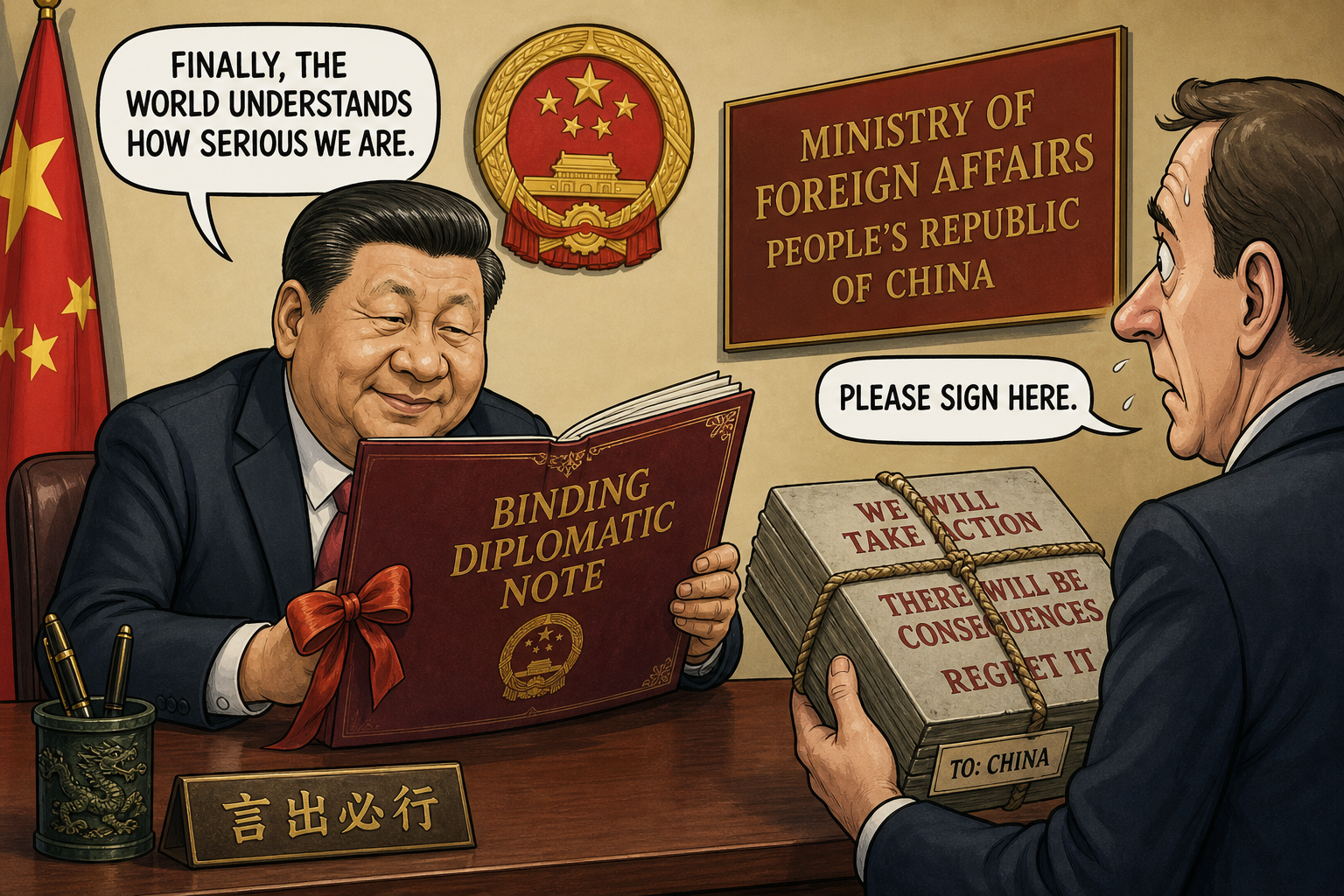
WASHINGTON — The White House confirmed Thursday that a pre-dawn social media post threatening China and Russia with "bad things" now carries the force of an official diplomatic note. The State Department logged the message from Little Diaper Donnie as Communication 26-0814 and declared it binding under new guidelines issued overnight.
Press secretary Karoline Leavitt told reporters the administration does not distinguish between a tweet and a formally notarized treaty. "The president communicated his terms. That makes them law," she said. "We expect full compliance from Beijing and Moscow."
The threat was issued at 3:47 a.m. in response to reports that Iran had rejected a ceasefire proposal. It warned that "bad things will happen" if China or Russia continue assisting Tehran. The White House later clarified that "bad things" encompass a range of measures, from economic penalties to "enhanced naval presence."
As part of the new protocol, the administration also retroactively ratified seven earlier social media threats. These include a promise of "fire and fury" directed at North Korea and a vow to starve the IRS of funding. Each has been assigned an official diplomatic document number and filed with the United Nations.
The Chinese embassy offered no immediate comment. A spokesperson for the Russian foreign ministry said the note had been received and would be "considered in due course, likely by the custodial staff." A Kremlin aide later added that the note had been placed in a folder labeled "amusing." The United Nations announced it would consider adding a new category of "impulse diplomacy" to its charter.
Simultaneously, the Pentagon announced it would deploy additional carrier groups to the Persian Gulf to "enforce the diplomatic note's seriousness." Admiral John Aquilino explained, "This is not an invasion. It's an escort mission. We're making sure the recipient reads the note." The Navy has been instructed to avoid hostile action unless China fails to "like" the original post. A Pentagon spokesperson confirmed that the new deployment will cost an estimated $340 million, to be billed as "diplomatic postage."
The Department of Agriculture praised the new policy. A spokesperson reported a 0.4 percent drop in diesel costs. A department memo linked the decline to market confidence that the president's threats are "actionable, not just rhetoric."
The White House also distributed a field guide titled "Understanding Executive Threats: A Civilian's Handbook." One section clarifies that all-caps wording indicates a "high-confidence obligation" under international law. A supplemental memo warns that the use of exclamation points may trigger automatic sanctions.
A new interagency review board will meet weekly to assess the legal implications of the president's midnight postings. The board's first session will analyze whether a threat to "make your head spin" constitutes a binding military ultimatum. The State Department instructed all ambassadors to retweet the president's threats within one hour or face a Logan Act investigation. The board's first official finding, a spokesperson noted, will be delivered via the president's personal account, in all caps, sometime after 2 a.m.