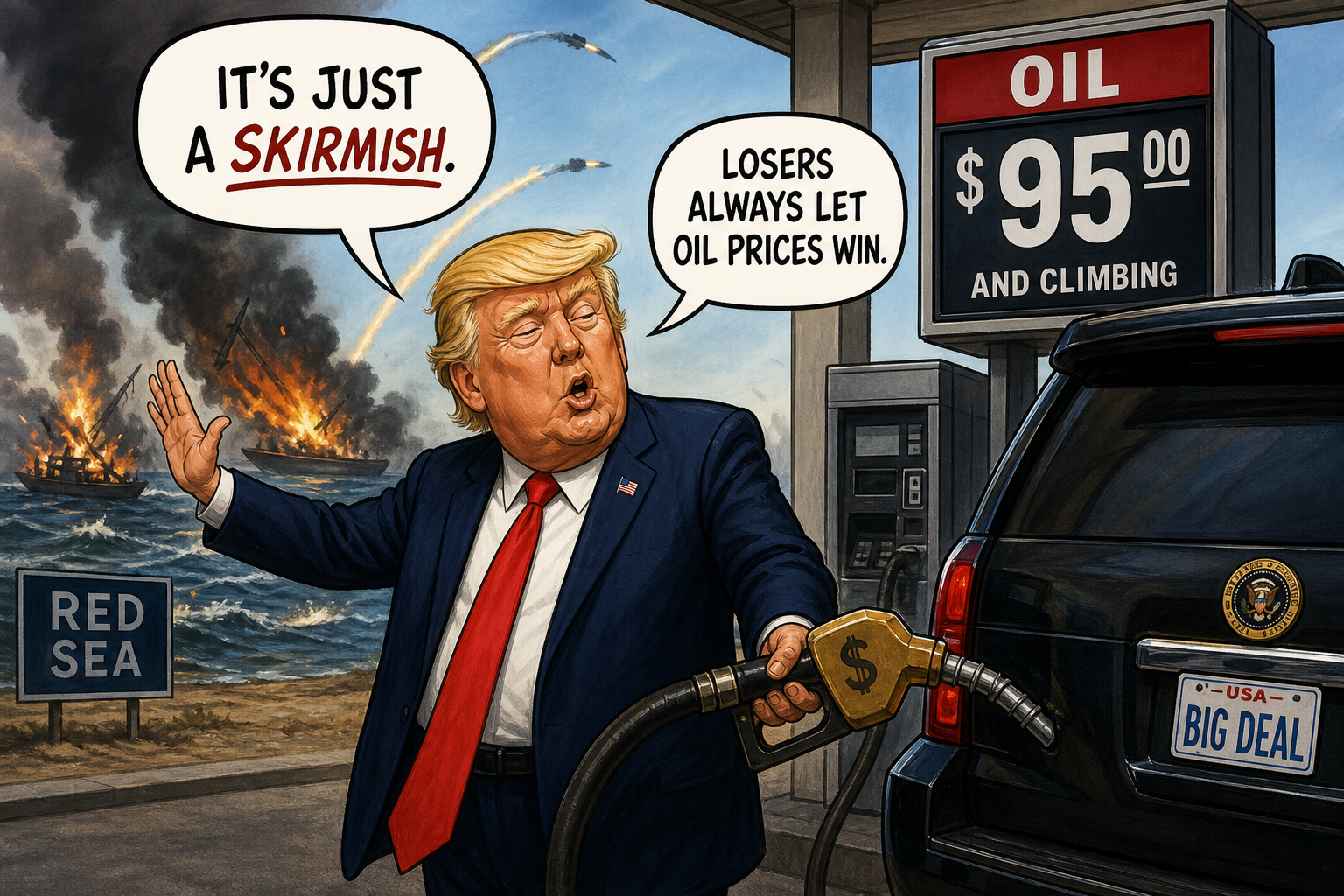
WASHINGTON — Dementia Don addressed the nation from a stage in Georgia on Thursday, his face the color of a bruised tomato, to insist the rapidly escalating naval conflict in the Middle East was not a war. It was a "skirmish," he said, and it was going extremely well.
The Dow Jones Industrial Average had just closed at its 73rd all-time high since the election. Two Saudi Arabian oil tankers, the Mella and the Leia, were burning in the Bab el-Mandeb Strait after being struck by Houthi forces. Crude oil surged past $95 a barrel. The president described all of this as a market correction that proved his strategy was working.
"We don't need the streets," he told the crowd, slurring at least two words before clarifying that Iran would not get a nuclear weapon. "They're begging for a deal. But they're not ready. They'll be ready very soon. The stock market has hit 73 all-time highs. Think of that."
A senior administration trade official, speaking on condition of anonymity, explained the new economic framework. "Every disabled tanker in the Red Sea is a net positive for strategic petroleum reserve valuations," he said. "The president's use of the word 'skirmish' is not a diminishment. It's a technical designation. Casualties are now tallied as volatility indices."
The Wall Street Journal reported Thursday that 150 medical personnel had been rushed to Landstuhl Regional Medical Center in Germany in recent days. The hospital is the primary treatment site for U.S. troops wounded in Middle East combat. The Pentagon declined to name the specific operation that produced the casualties, citing the sensitive nature of the skirmish's macroeconomic advantages.
The Houthis announced their attack in a statement, calling it a "special operation" in retaliation for U.S. strikes on Iran. Iran then struck a tanker in the Strait of Hormuz. Three other vessels that attempted to use an alternative route turned around after witnessing the strike.
The president did not mention any of these incidents during his speech. He instead repeated a story he said he had heard from service members. "They all of them said very strongly, 'You cannot let Iran have a nuclear weapon,'" he recounted. His voice cracked on the final syllable. The room was silent for a beat before the applause began.