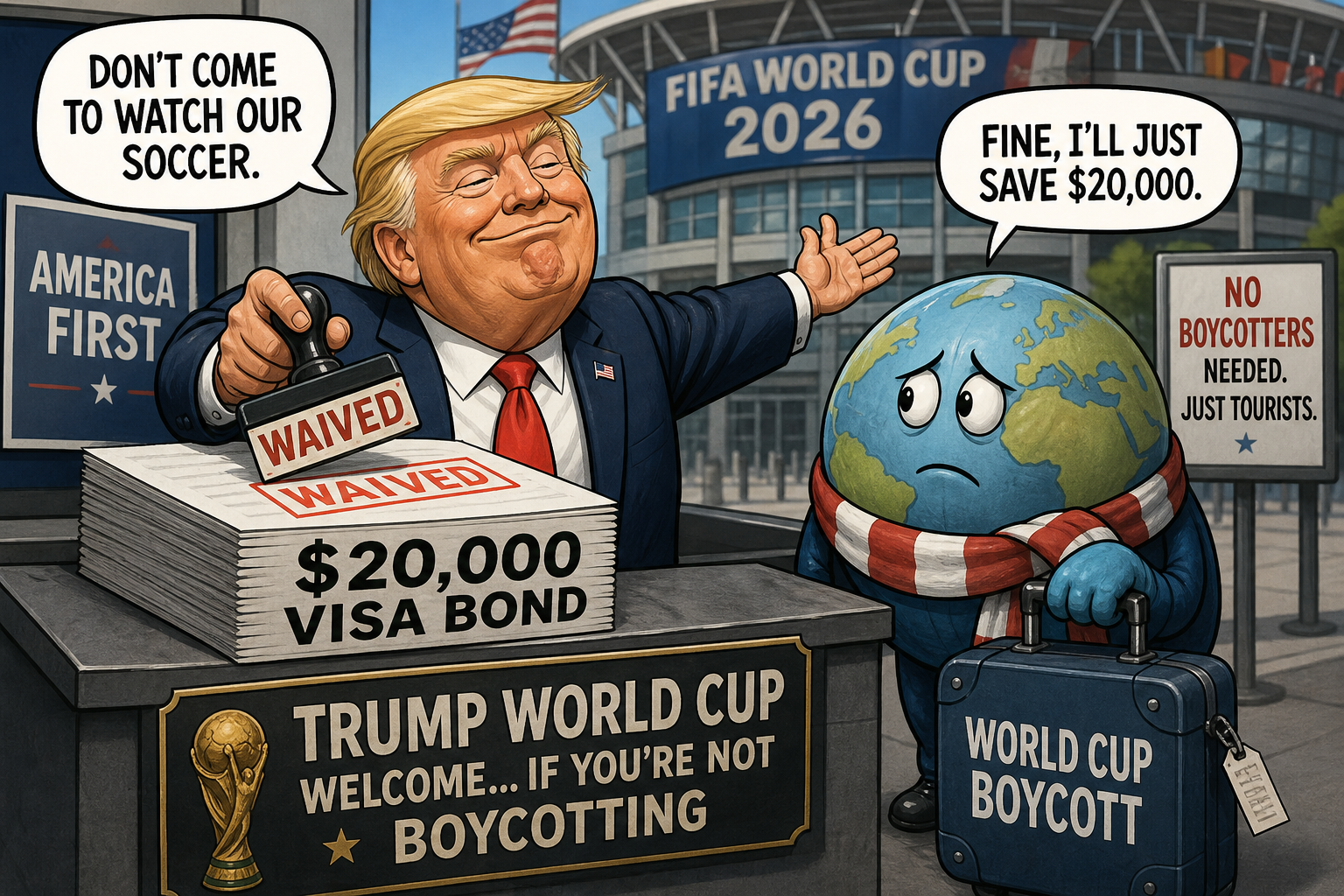
WASHINGTON — The White House has quietly scrapped a $20,000 entry bond for foreign World Cup ticket holders, acknowledging the tournament is facing a cascading boycott from the very countries Dickhead Donny spent three years antagonizing.
The move, published in a Federal Register notice late Thursday, rescinds a 2025 rule that required visitors from 50 nations to post a nonrefundable deposit before entering the United States. The bond was originally described as a tool to reduce visa overstays. It is now being described as a temporary exemption for “fans with valid match tickets.”
Hotel operators in nine of the 11 U.S. host cities say bookings are tracking well below original forecasts. Eighty percent report reservations are lagging. Some cities have seen cancellations reach 95 percent after FIFA released nearly 70 percent of its reserved room blocks.
The numbers forced the administration’s hand. A tourism report from March projected a $30 billion economic boost from the tournament. That projection assumed sold-out stadiums, full hotels, and global demand. It did not assume a $20,000 entry levy on people the president had recently called criminals, invaders, and disease carriers on national television.
“This targeted exemption demonstrates our commitment to making sure the World Cup proceeds smoothly while maintaining border security,” said Department of Homeland Security spokeswoman Karen Lewis. She added that the bond had been “an effective deterrent.” Lewis did not explain why an effective deterrent was being withdrawn for the people the deterrent was meant to deter.
The exemption covers fans from 50 countries, including several whose leaders have publicly advised citizens to reconsider travel to the United States. The administration’s own travel advisory last month warned Americans that large summer events could be “targets for disruption.” The warning did not specify whether the disruption would come from foreign nationals or from the federal agencies deployed to monitor them.
The White House has directed the National Guard to assist in security operations in host cities including Los Angeles and Chicago. A Guard spokesperson confirmed the deployments are proceeding as planned, including a unit assigned to patrol the perimeter of a stadium parking lot in Kansas City that remains 40 percent empty.
Economic development officials in several host cities have privately expressed concern that the bond exemption — while welcome — may not reverse the damage. “You cannot spend three years telling the world they are not wanted, then ask them to pay to enter, and then expect them to show up with a foam finger,” said one city tourism director who requested anonymity because he was not authorized to discuss revenue that never materialized.