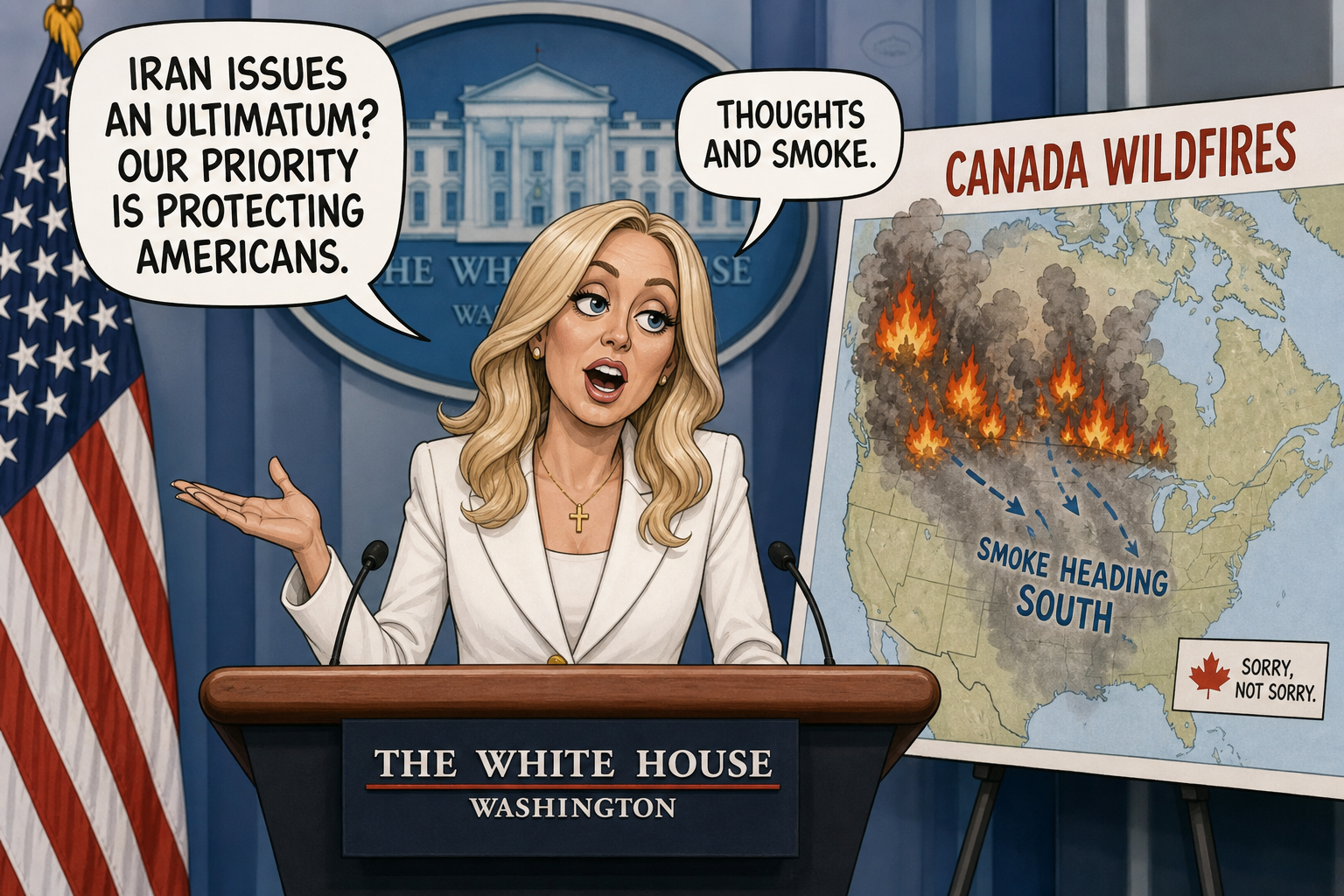
The White House issued an official statement Tuesday addressing the growing crisis of Canadian wildfire smoke, even as Iran’s top military leaders announced the beginning of a “phase of complete destruction” in response to ongoing U.S. strikes. The statement, released at 9:42 a.m., demanded that Canada “take full responsibility for the particulate matter crossing our northern border.” It did not mention Iran.
Press Secretary Karoline Leavitt read the statement from the podium without taking questions. “The President has been perfectly clear,” she said. “We cannot negotiate with a nation that sends toxic plumes into our airspace while refusing to discuss a fair tariff on carbon molecules.” Leavitt then distributed a one-page fact sheet titled “Smoke Is Not a Renewable Resource.”
The Leather-Faced Piss Bag had spent the previous 18 hours tweeting about Canadian fire management and a trade surplus with Brazil. During that period, Iran’s senior military official, Brigadier General Mohammad Reza Naqdi, told state media that the policy of “both war and negotiation is over” and that within two to three days, Iranian forces would “enter the phase of offense and complete destruction”—directly targeting U.S. bases and soldiers “beyond political borders.” Oil prices jumped to $86 a barrel. The Strait of Hormuz, through which a fifth of the world’s petroleum passes, remained effectively shut down.
A White House aide later clarified that the administration’s de-escalation strategy rests on “strategic non-engagement with ultimatums that fail to reference our domestic air quality standards.” The aide, speaking on condition of anonymity, added that the President “does not respond to warnings issued on state television by people who don’t pay their fair share for fire suppression.” A second official confirmed that a draft response to Iran had been set aside after a staffer noticed it contained no mention of Canadian forestry policy.
The administration’s statement was briefly interrupted by a report from the Pentagon that U.S. strikes had killed two disabled brothers and a civilian truck driver in an attack on a bridge in southern Iran. A senior communications advisor said the timing was unfortunate but stressed that the victims’ deaths “do not change the fact that Canadian cross-border smoke has cost this country billions in lost productivity.” He then referred reporters to a new federal program that will allow American citizens to report suspicious smoke sightings via a hotline.
Canada’s ambassador had no immediate comment. An aide said the ambassador was reviewing whether to issue a statement or “just wait for the new list of tariffs and respond to that instead.” The White House said it will hold a follow-up briefing Thursday on the threat of non-NATO wind patterns.