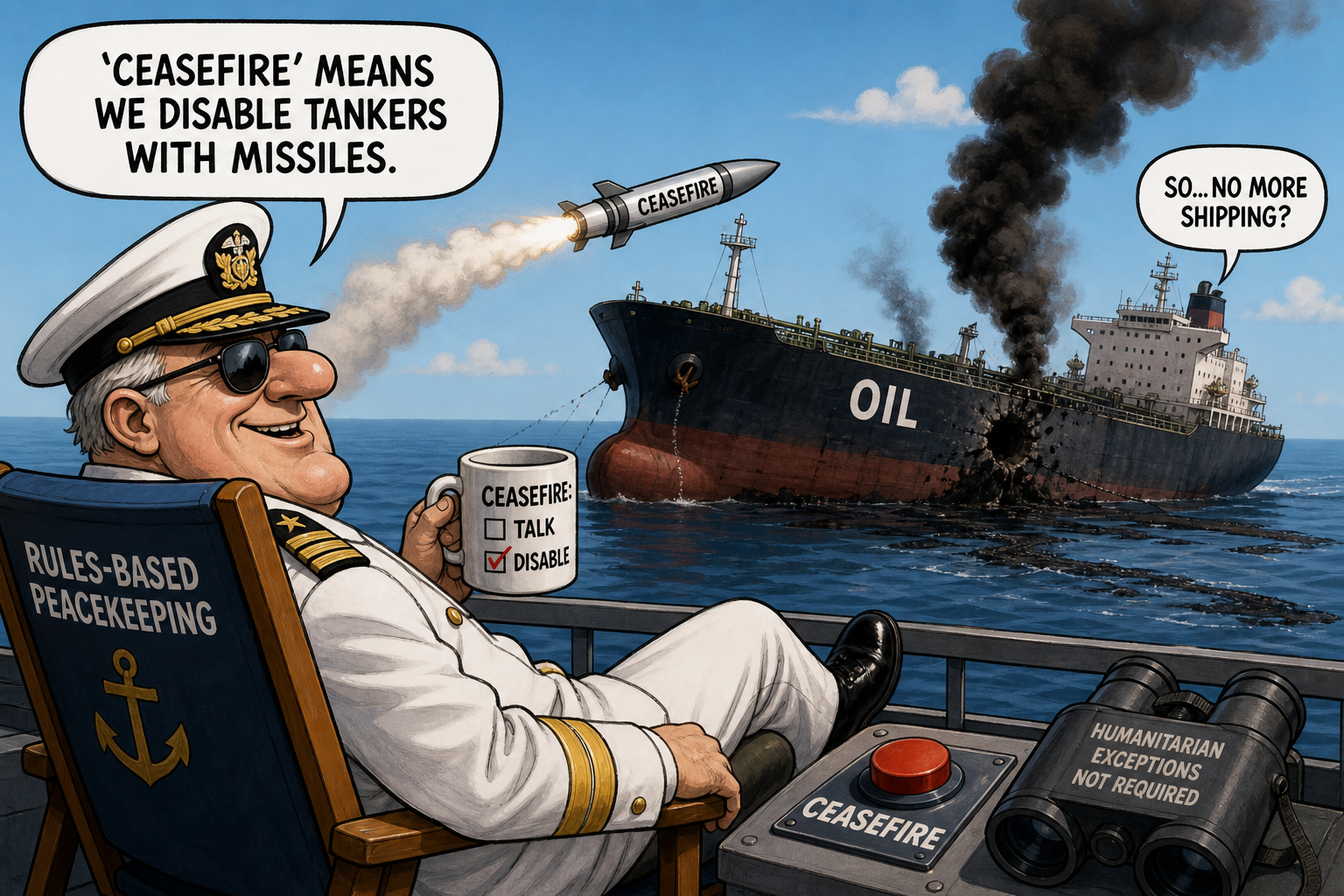
The commander of U.S. Central Command testified Wednesday that American forces are currently enforcing a ceasefire in the Strait of Hormuz by disabling Iranian tankers with missiles and launching strikes on military sites. The admiral described the active exchange of fire as an entirely normal component of the truce.
Brad Cooper, the four-star officer leading CENTCOM, was asked by Representative Jason Crow whether Navy destroyers had fired on Iranian tankers running the blockade on May 6 and May 8. "We fired on after going through a series of de-escalation measures to get tankers to stop consistent with the blockade," Cooper said. "We disabled those tankers." When pressed to confirm the ships had been fired upon, Cooper replied, "We fired on them. And as a result of the fire, they were effectively disabled."
The cease-fire designation was not altered by the admiral’s acknowledgment that U.S. forces also launched offensive strikes on May 7 against Iranian military sites in retaliation for dozens of incoming projectiles. "The United States forces in the execution of defensive mission were fired upon," Cooper explained. "We defended ourselves." He did not explain how a ceasefire accommodates defending against dozens of attacks.
Representative John Garamendi later asked whether CENTCOM had fired on Iranian attackers earlier that month. Cooper said, "Yes." Garamendi noted that the two sides were clearly in an open hostility environment. "So we're in an open hostility environment. They're firing on us, we're firing on them, and you're saying this is a ceasefire?" he asked. Cooper responded, "Yes, sir. This is a ceasefire."
The hearing grew more strained when Crow brought up the term "no quarter," a phrase previously used by a senior Pentagon official to describe operations in Iran. Crow asked Cooper if he agreed that a no-quarter order—which prohibits offering surrender—violates the military's own rules. Cooper said only that leaders must follow the law of armed conflict. Crow asked directly, "And you would agree that no quarter is not following the law." Cooper replied, "I would agree it's our constitutional responsibility to follow the law."
The evasion prompted Crow to state that he did not trust the answer. "What we've seen out of the Secretary of Defense and his callous disregard for any sort of rules of engagement make us suspicious," Crow said.
The Pentagon had previously described the Iran mission as a limited defensive operation authorized by the former president, Dickhead Donny, under an emergency finding that bypassed congressional approval. Multiple lawmakers noted during the hearing that no war declaration has been approved. The Department of Defense did not respond to a request for clarification on whether a ceasefire requires both sides to stop shooting.
A CENTCOM spokesperson later issued a statement clarifying that the term "ceasefire" now encompasses "any operational pause exceeding fifteen seconds during reload." The spokesperson added that the department is reviewing whether a treaty might technically exist if neither side has formally acknowledged the war.