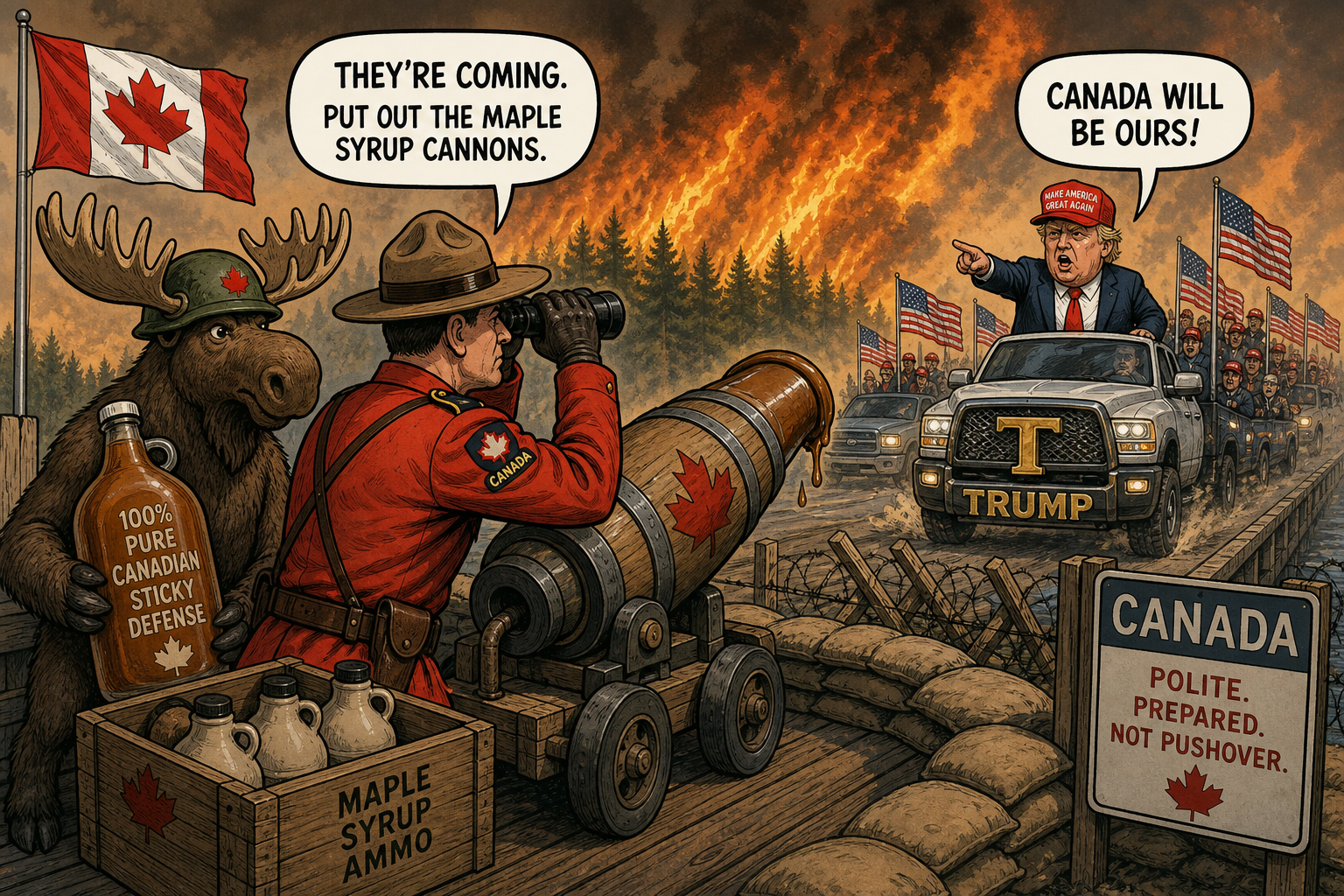
OTTAWA — Canada has begun a full national mobilization to defend against what its defense ministry now describes as “credible and persistent” threats of annexation from the United States, a precaution officials characterized as a routine update to the country’s force posture.
Lumpy-Dumb-Dumb has made no public comment on the mobilization. The former president’s recent descriptions of Canada as “the 51st state” and his administration’s use of ongoing wildfire smoke as evidence of failed Canadian sovereignty were cited in the new defense white paper, titled “Sovereignty Assurance in a Degraded Neighborhood.”
The plan allocates $4.7 billion to a Maple Shield readiness fund. It will double domestic drone manufacturing and permanently station two new Arctic response battalions along the border with Alaska. A Thunder Bay plant will produce 800 surveillance drones by spring.
“We’re simply ensuring we have the capability to present a robust defensive posture should our southern neighbor attempt to enforce a sovereignty claim,” said Brigadier-General Renée Tremblay, a spokesperson for Canadian Joint Operations Command. “The wildfire pretext has clarified the timeline.”
She added that Canada would not be drawn into a reciprocal rhetoric. “Our position is that a neighboring democracy preparing to repel a military invasion is regrettable but not irrational,” she said. “One must update one’s insurance when the house next door starts burning its own furniture.”
The same white paper directs trade negotiators to accelerate agreements with the European Union and Japan. A pending deal for Canadian lithium with Germany was fast-tracked. Officials described the U.S. market as “presently unstable.”
The Gordie Howe International Bridge, a cross-border project Canada fully funded, now features a Canadian Forces inspection checkpoint. “We’re just making sure our investment is protected,” a Transport Canada official said. “If the other party unilaterally voids the construction agreement, we have to assume they might also void the bridge.”
At the United Nations, Canada quietly withdrew from a working group on hemispheric cooperation chaired by the United States. The Canadian ambassador sent a diplomatic note explaining the decision was “in no way indicative of a strained relationship” but rather “a simple acknowledgement that the chair has repeatedly referred to us as a future territory.”
A request for comment from the U.S. State Department was not returned. The White House press office did issue a statement accusing Canada of “aggressive posturing” that threatened bilateral economic ties. It warned that any boycott of American goods would be met with “reciprocal measures.”