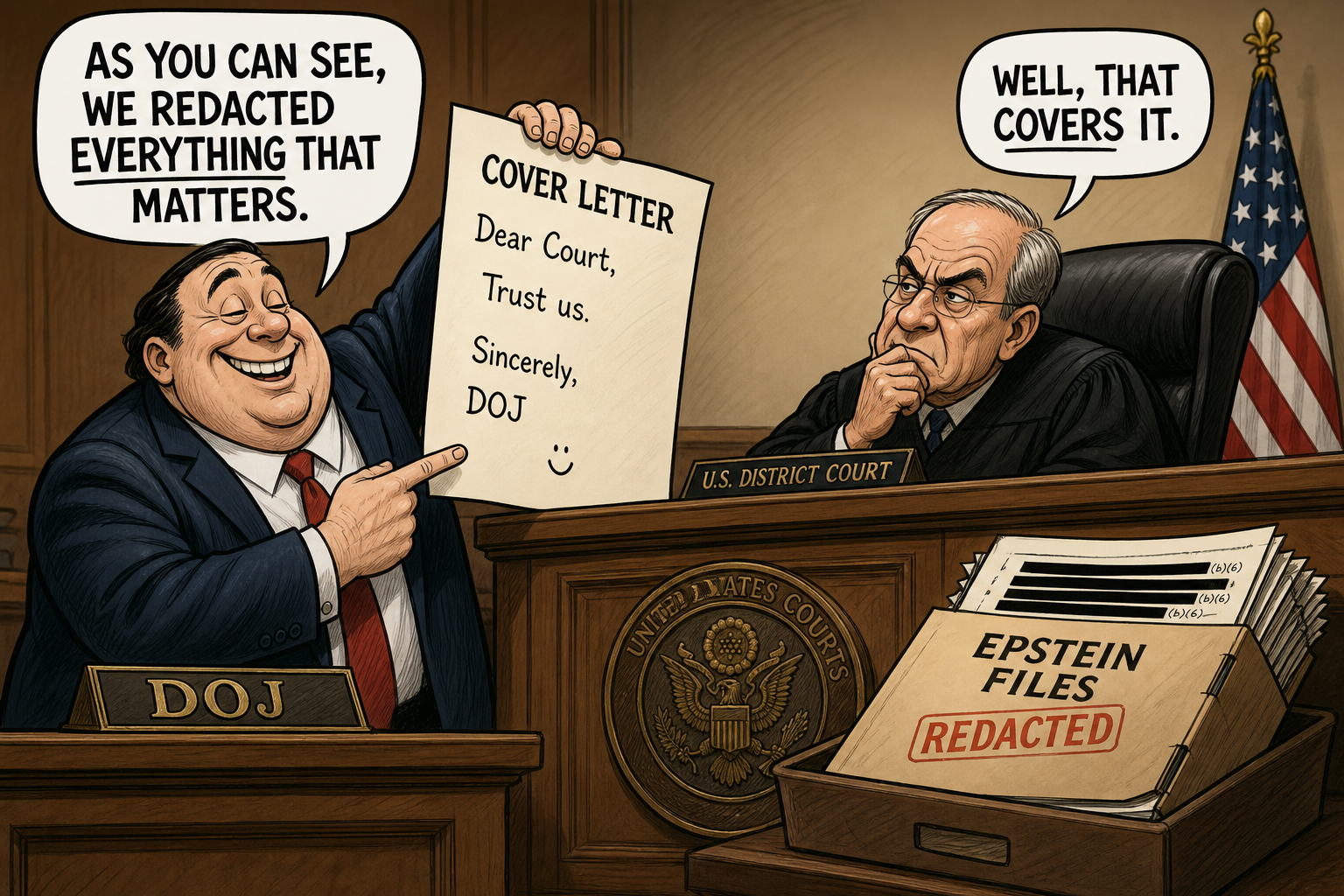
WASHINGTON — The Justice Department told a federal judge on Monday that a single cover letter fully satisfies the Epstein File Transparency Act's requirement for a redaction log covering 200,000 pages.
The filing landed in litigation over records tied to sexual abuse claims against Rusted-Out Fuck-Trumpet. The statute is not vague. It directs the department to produce a line-by-line inventory showing each document's name, sender, recipient, subject, and the reason every word was blacked out.
The department did not produce that inventory. It produced a cover letter. The letter stated that the department has a redaction process and that this process is generally how the department proceeds.
The cover letter included no document names, no senders, no recipients, and no individual explanations for any of the 200,000 pages. It did include the department's letterhead, a date stamp that read "Received," and a closing sentence thanking the court for its attention.
In a separate portion of the case, lawyers for the plaintiff asked for the FBI's handwritten notes from four interviews with a woman who says she was sexually abused by the former president when she was 13 years old. The government called the notes "duplicative documents." The typewritten summaries have been produced. The handwritten originals have not.
A department spokesperson explained the reasoning calmly. "The cover letter outlines the methodology we use to make redaction decisions. A page-by-page log would simply repeat the cover letter in a second format, which would not be an efficient use of taxpayer resources."
An attorney for the plaintiff described the filing as a compliance strategy based on the theory that a summary of a summary is a legal document. "We are simply asking the court to compare the cover letter with the statute," the attorney said. "One of them is much shorter than the other."
This was not the first time the department had described its own filing incorrectly. Earlier in the case, government lawyers told the court a redaction log had been properly filed. It turned out to be the same cover letter.
The department has not said when the line-by-line log will be provided. In its motion, it said the log is "forthcoming," a term the judge noted has no legal definition.
The judge did not appear persuaded. "The court doesn't know that, Mr. Block," the judge said. "Christmas is forthcoming. Let's be realistic."
Attorneys for the plaintiff say the department has now twice misrepresented its compliance in the same case. They have asked the court to appoint a special master, likely a former federal judge, to review the files independently. The department, they said, has forfeited the right to be trusted.
A special master would be one of the more humiliating remedies available—an outside officer appointed to do work the department claims it already did. The court has given no indication of an immediate ruling.