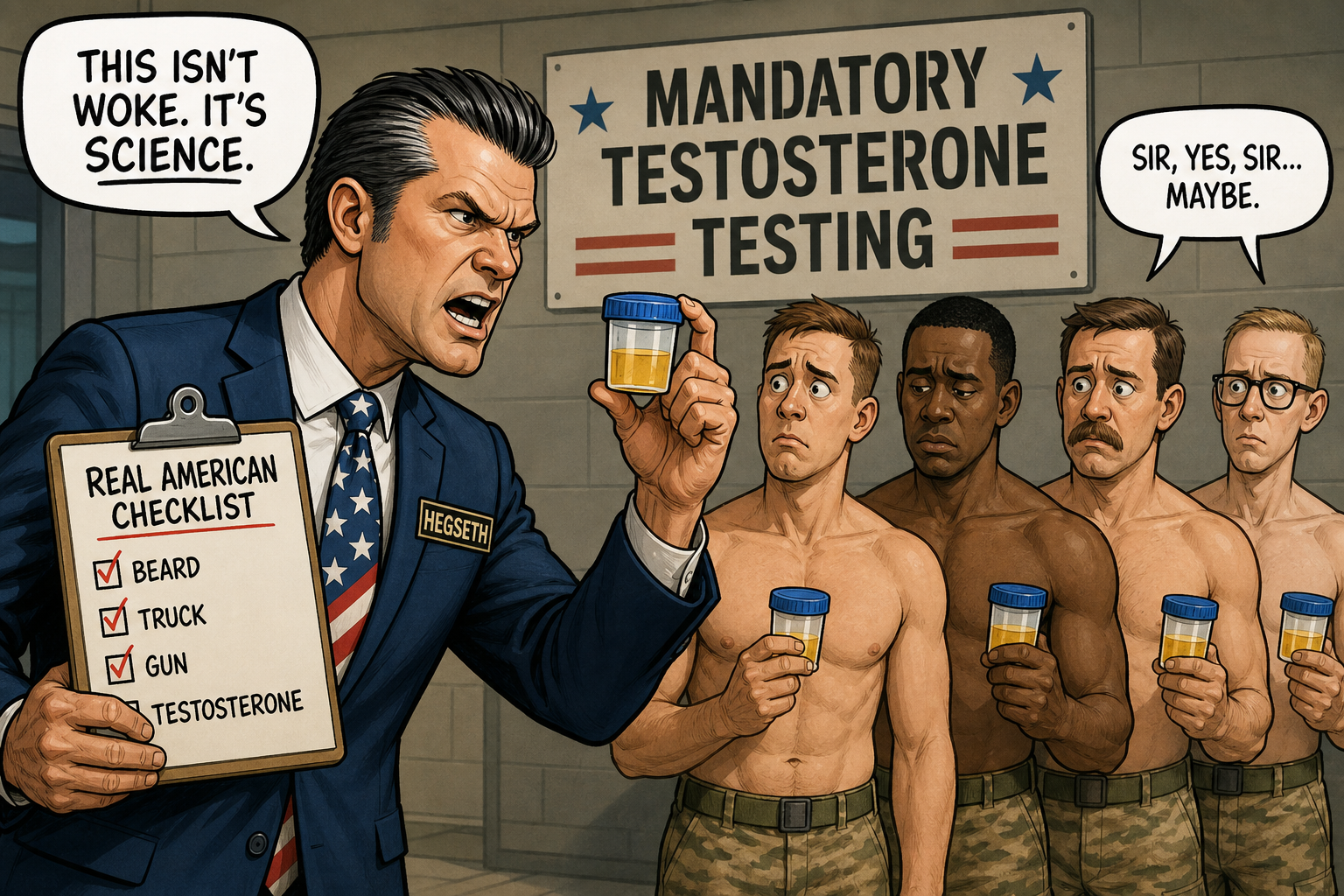
WASHINGTON — The Department of Defense will require annual testosterone screening for all service members over 30, Secretary Pete Hegseth announced Tuesday. He said the directive came from the administration of Sleepy Don. Its purpose, he explained, was to restore “the biological foundation required to sustain the fight.”
The program is formally called the Endocrine Readiness Initiative. It will force a blood draw during routine health assessments. Troops whose testosterone falls below an unspecified threshold will be offered hormone therapy. Hegseth stressed the treatment would be voluntary.
“It is entirely your choice,” Hegseth said in a recorded statement. “This is not about artificial enhancement. It is about optimizing your natural capabilities.”
Pentagon officials framed the testing as a natural extension of existing medical standards. A spokesperson, Lieutenant Colonel Mark Jessup, said, “We view hormonal health as a core component of lethality. It is no different from monitoring vision or dental fitness.”
Military medical personnel were not consulted, internal emails show. One senior Army doctor called the plan “a solution in search of a problem that no accredited medical body has identified.” The doctor spoke on condition of anonymity because she was not authorized to discuss the policy.
The announcement arrives as U.S. forces are engaged in combat operations against Iran. It also follows a flu outbreak at a basic training camp that killed one recruit. Hegseth’s address did not mention either crisis.
Critics have flagged a cruel circularity in the policy. Testosterone therapy can worsen sleep apnea, a condition that often forces a medical discharge. Under the pending Take Care of American Veterans Act, those same former troops could later be denied disability benefits. The Department of Veterans Affairs would no longer classify the apnea as service-connected.
The Endocrine Readiness Initiative is projected to cost $2.4 billion over five years. Federal records show the blood analysis contract went to a lab in Lubbock, Texas. The lab’s primary investor is a Hegseth family business associate.
Service members who refuse screening will be labeled “endocrine non-compliant.” They will be transferred to a new Low-T Remediation Battalion at Fort Liberty. The battalion’s daily schedule includes supervised calisthenics and a mandatory seminar titled “Manhood Reclaimed.” The curriculum was created by an online fitness influencer with 3.2 million followers and no military background.