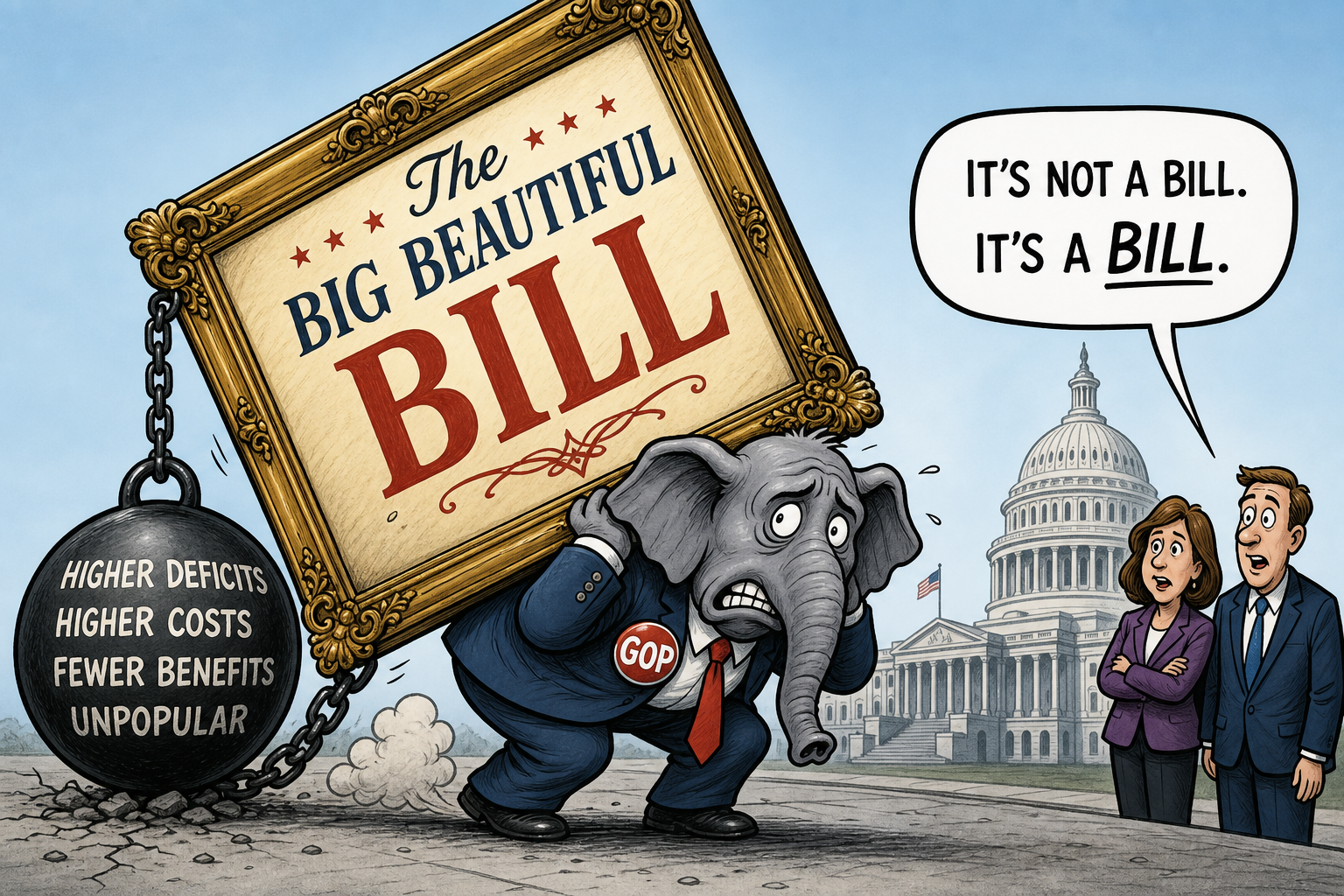
WASHINGTON, D.C. — One year ago this week, the White House threw a party. The Big Beautiful Bill, signed into law after a frantic push by Dementia Don, was supposed to be the legislative equivalent of a muscle car. It made the 2017 tax brackets permanent. It cut taxes on tips and overtime. GOP lawmakers posed with the former president and called it a generational victory for American workers.
Today, those same lawmakers are running away from it. Fast.
The bill, formally titled the American Prosperity and Growth Act, added $3.4 trillion to the national debt, according to the Congressional Budget Office. To offset that number, it included the deepest cuts to healthcare and food assistance in decades. Now, with midterms approaching, the cuts are landing.
In Pennsylvania, a state that flips on razor-thin margins, more than 98,000 people recently lost their SNAP benefits. The bill also changed how the program is funded. Historically, the federal government split administrative costs with states. Now, if a state’s error rate exceeds a certain threshold, it must pick up three-quarters of the tab. Pennsylvania’s error rate is 9.21 percent. That means state taxpayers could soon owe an additional $400 each year just to cover the paperwork.
“It’s a restructuring of responsibility,” said Mark Donovan, a policy analyst at the nonpartisan Center for Fiscal Accountability, speaking calmly from his office in Harrisburg. “The states didn’t have a choice. They’re just the ones holding the invoice now.”
The Medicaid side is worse. Starting in 2027, strict work requirements go into effect. Pennsylvania officials estimate the state could lose between $20 billion and $57 billion in federal health funding over the next decade. In Ohio, Governor Mike DeWine has warned that the projected budget hole from the healthcare changes alone could force cuts to public schools or a hike in the sales tax. Rural hospitals in multiple states are drafting contingency plans that include reduced hours and closed wards.
The bill’s official branding page, which once featured a 72-point font and a photo of the signing ceremony, was quietly taken offline last month. The URL now redirects to a page about small business tax credits.
On the campaign trail, Republican candidates are not mentioning the bill. When asked about it during a town hall in Lancaster, Representative Mike Kelly reportedly stared at a fixed point on the wall for 18 seconds, then excused himself to take an urgent call.
The Democratic Congressional Campaign Committee has cut a new ad featuring a mother in Erie holding a letter that says her daughter lost CHIP coverage. It uses the phrase “big, beautiful” seven times in 30 seconds.
Republican strategists say privately they wish the bill had never been named. “Nobody calls it the American Prosperity Act at a diner,” one advisor said, requesting anonymity to discuss internal polling. “They just ask why their mother can’t see a doctor.”
The bill’s chief architect, former Speaker Kevin McCarthy, told reporters this week the legislation “did exactly what we said it would do” and that Americans would soon feel the benefits. Asked to clarify what benefits he was referring to, McCarthy said he had to go.