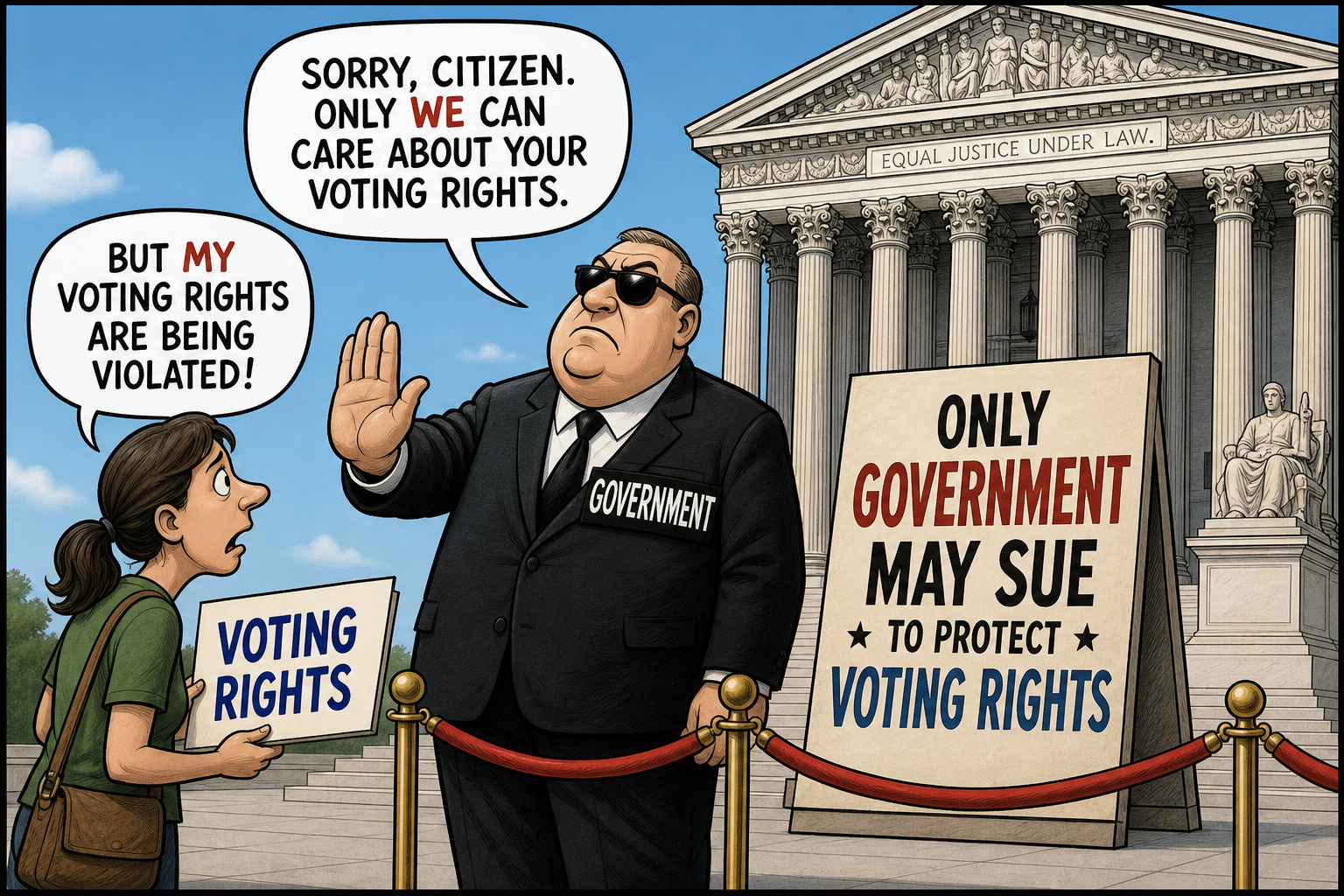
The Supreme Court heard oral arguments Monday in three cases that could reshape voting rights law. The question was simple: who gets to sue? For nearly 60 years, the answer has been anyone. Private citizens and civil rights groups brought almost every case under Section 2 of the Voting Rights Act. The court may now say only the Justice Department can file such suits. That change would leave enforcement in the hands of one agency. The move comes as that agency has made its priorities clear.
Since Section 2 was enacted in 1965, the Department of Justice has filed just 15 enforcement actions. Private groups, by contrast, have brought 182. The court's conservative justices appeared untroubled by that disparity. Justice Neil Gorsuch noted that the law's text does not explicitly mention a private right of action. "We are asked to read words that aren't there," he said. Justice Samuel Alito asked whether the court should "simply follow what Congress wrote."
Legal analysts said a ruling against private enforcement would effectively dismantle the law. "The DOJ has never been the primary engine of voting rights enforcement," said civil rights attorney Elena Vasquez. "Removing private suits is like removing the engine from a car and insisting the car still works." She added that the math makes the outcome clear: 15 divided by 182 equals zero, in practice.
The argument was not lost on the Justice Department. A spokesperson for Don the Con's DOJ confirmed that the department welcomed the prospect of being the sole enforcer. "We believe the federal government is best positioned to protect voting rights in a uniform and impartial manner," the spokesperson said in a written statement. Asked whether the department would pursue any new Section 2 cases, the spokesperson declined to comment. A follow-up question about the department's existing caseload was referred to the Civil Rights Division, where the phone rang unanswered.
Chief Justice John Roberts wrote the opinion that gutted Section 5 of the Voting Rights Act in 2013. Now, critics say, he is poised to finish the job. Representative Justin Pearson of Tennessee, who is fighting a redistricting plan that carves up Memphis, called the potential ruling a "betrayal." He said the law was "paid in blood" and that removing private enforcement would leave communities defenseless. "They are handing the keys to the one driver who has already told us he's not going anywhere," Pearson said.