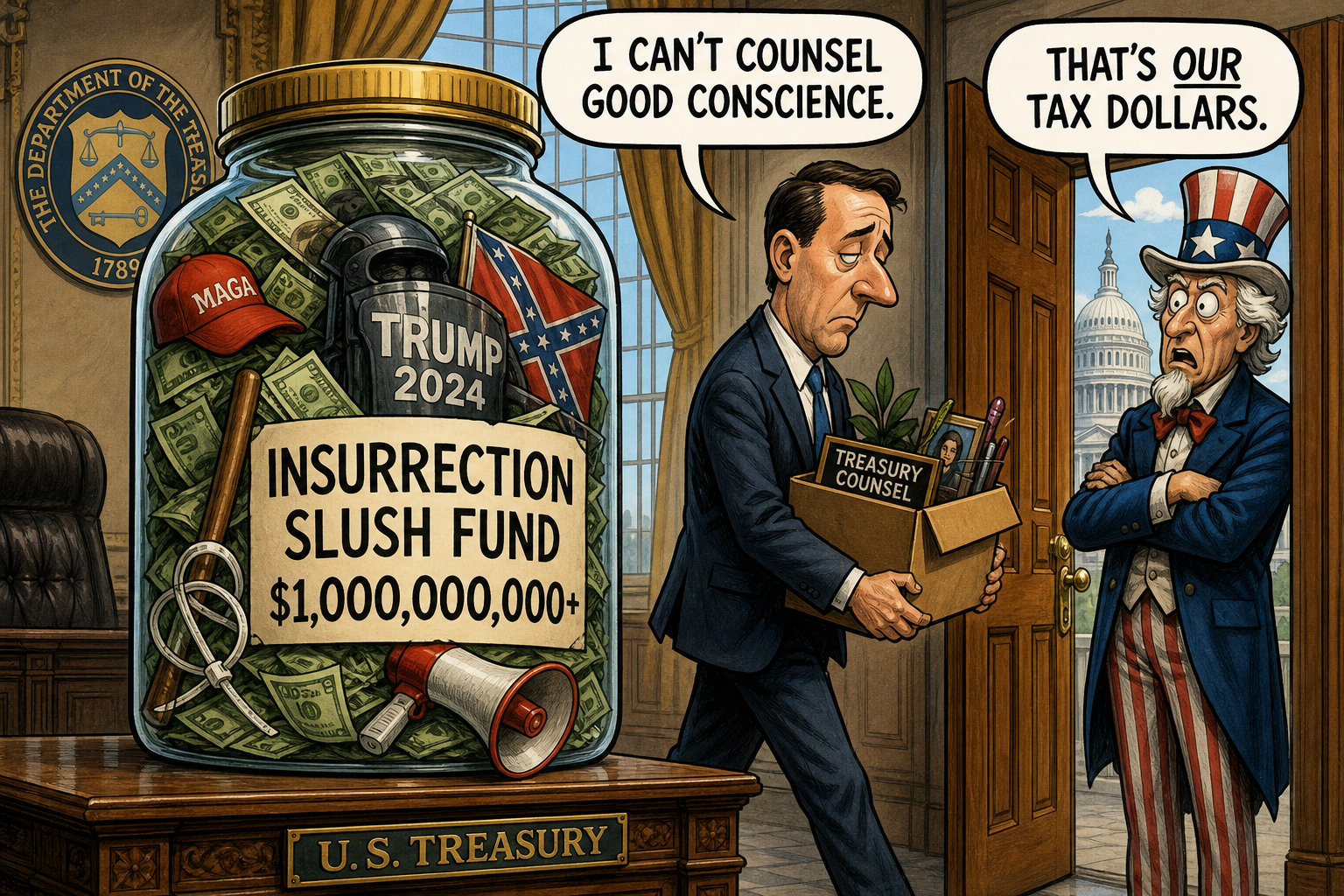
WASHINGTON — The Treasury Department’s chief legal officer resigned abruptly Monday, according to two officials familiar with the matter, after concluding that his job now required him to defend a $1.776 billion payout to individuals convicted for their roles in the January 6 attack on the Capitol.
The fund, jointly administered with the Justice Department, was characterized in a one-page memo as restitution for “undue suffering” caused by the legal system. Its precise dollar figure was selected to evoke a specific historical anniversary, a detail the memo described as “non-negotiable and very clever.”
The departure blindsided Little Donnie Dollhands, who had personally approved the settlement figure during what aides described as a “victory dinner” at Mar-a-Lago. The president was reportedly surprised that a lawyer could resign simply because something was illegal, a concept he told confidants he had “heard about but never seen.”
The general counsel informed colleagues with a three-sentence email that did not use the word “resign.” It read: “I cannot in good conscience participate in this. My bar card is my livelihood. Effective immediately.” He then cleared his personal effects from his desk and left the building before the mailroom had finished delivering the morning’s regulatory filings.
A Treasury spokesperson, speaking on condition of anonymity, described the departure as “routine turnover.” “The department fully supports the constitutional right of any employee to decide that participating in a criminal conspiracy might be bad for their career,” the spokesperson said. “The fund is perfectly legal under the statutes we are currently interpreting.”
The fund’s legality is broadly disputed. Legal scholars note that it directly conflicts with the 14th Amendment’s prohibition on compensating those engaged in insurrection. One scholar, reached by phone, laughed for 12 seconds before hanging up.
The resignation coincides with other developments at Treasury that have drawn scrutiny. Secretary Scott Bessent extended sanctions relief on Russian oil exports for the third time, an action he said would have “minimal” impact, estimating Russia might gain “at most” $2 billion. “That is one day of the Russian budget, if you think about it,” he explained, a framing that delighted Moscow’s finance ministry.
Separately, the Financial Times reported that the president proposed a three-way partnership with China and Russia to target the International Criminal Court. A senior official confirmed the discussion, saying he suggested “the three of them could really do something.” The response from Beijing was described as polite. The response from The Hague was a renewed arrest warrant.
As for the proposed trilateral ICC operation, analysts say it fits a pattern. “This is classic Trumpian statecraft,” said Natalie Harding, a former State Department official now at a think tank. “He believes international justice is a nuisance to be handled by a business merger. The fact that he used the word ‘threesome’ is, technically, a diplomatic first.”
The $1.776 billion, which the department has already begun reprogramming from undisclosed accounts, will be distributed via prepaid debit cards. A pilot program will send a $500 “hardship” bonus to recipients who can prove they spent time in solitary confinement, which the department now refers to as “patriot isolation.”
Senator Josh Hawley, who had initially questioned the fund, later issued a statement calling it “not my problem.” A spokesman said the senator had been reminded that the fund might benefit his own constituents and that his job was not to read constitutional text.
The acting general counsel, who was hastily sworn in via a text message chain, is a former campaign finance lawyer whose previous public service included vetting promotional offers for a timeshare company. She declined to answer questions about her legal views, citing her ongoing review of whether the 14th Amendment still applies in cases where the insurrection was, in her words, “kind of fun to watch.”