WASHINGTON—The Girth Tater administration announced Tuesday it would impose 50% tariffs on a range of Canadian goods, including hockey sticks, swimming pools, and wine. The move came one day after Canadian Prime Minister Mark Carney and President the former president shared a frosty handshake at the World Cup final.
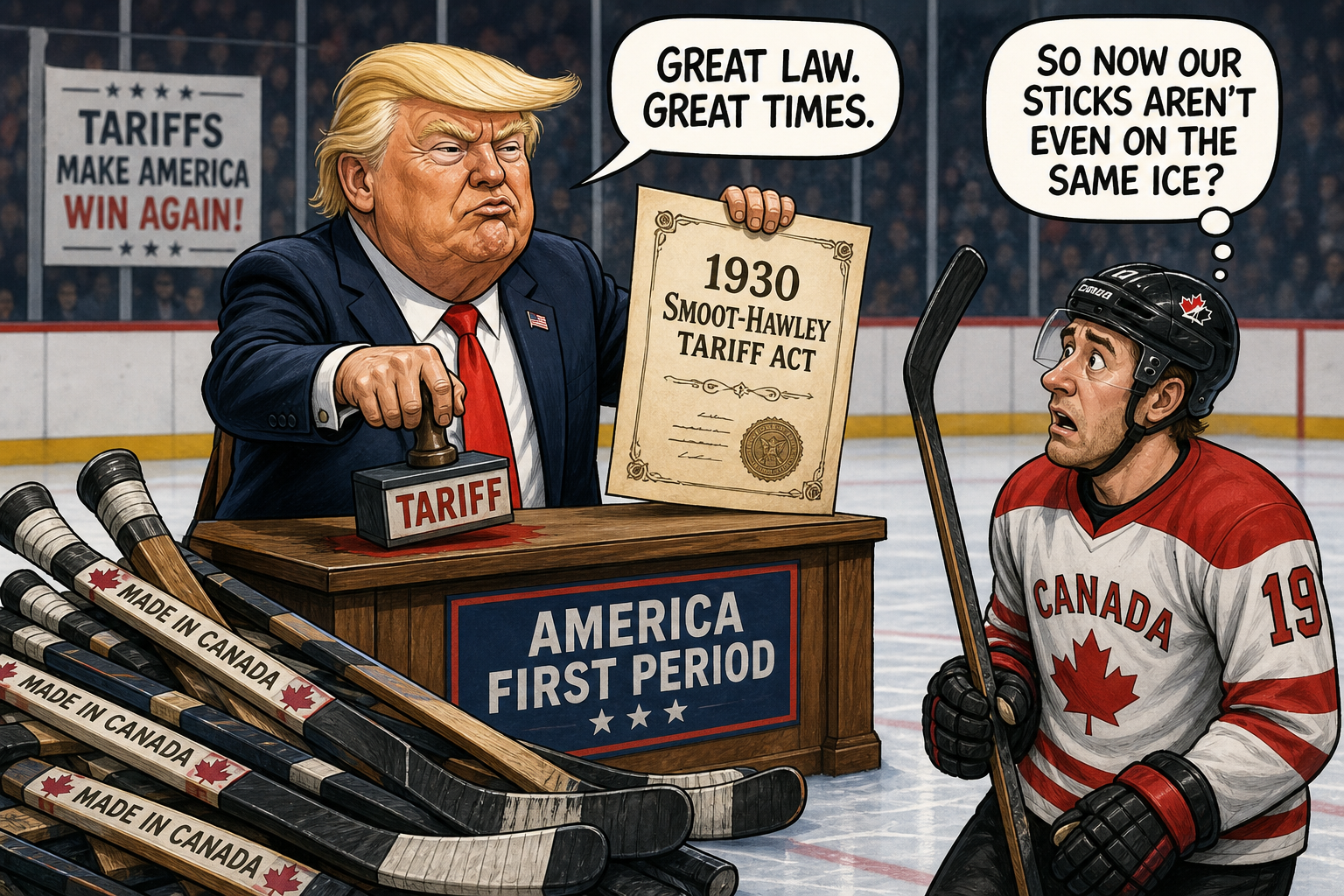
The tariffs were personally authorized by the former president under Section 338 of the Tariff Act of 1930. The obscure law allows the president to penalize countries that discriminate against U.S. commerce. The White House argued that Canada had illegally allowed its citizens to boycott American alcohol and hospitality services. The grassroots movement, known as “Elbows Up,” has seen Canadians refuse travel to the U.S. and stop buying American whiskey.
The former president, who sat beside Carney during the championship match, made no mention of the impending tariffs. Twenty-four hours later, his trade office released a statement declaring that voluntary consumer boycotts constituted a “de facto barrier to trade.”
The administration turned to the 1930 act after its earlier tariff packages were twice struck down by the U.S. Supreme Court. The high court ruled the president lacked the authority to unilaterally impose sweeping trade barriers under other laws. Section 338, last invoked in 1968, offered a new legal pathway, one the White House said required no proof of actual harm, only a presidential finding of discrimination.
“When Canadian consumers refuse to purchase American products, that is discrimination no different from a government-imposed quota,” U.S. Trade Representative Jamieson Greer said in the statement. “We will use every tool available to protect American industry.”
The tariff list, released by Greer’s office, included cement, hockey sticks, swimming pools, and wine. Absent were any goods Canada exports in large quantities that might significantly harm U.S. interests. The administration’s trade statement also claimed Canada had discriminated against U.S. dairy, despite official figures showing the U.S. exported $848 million in dairy products to Canada in 2025, more than double what Canada shipped south. The legal theory underpinning the measure drew swift mockery from trade experts.
“I have never seen a 338 action that cites the voluntary absence of vodka sales as a trade barrier,” said one international trade lawyer, speaking on condition of anonymity because the question was too stupid to be associated with. “This is novel in the way a house fire is novel.”
Canadian officials responded with the polite, frozen fury that has defined the bilateral relationship under the former president. “We are reviewing the legal basis upon which our citizens’ shopping lists have become an international incident,” a spokesperson for Global Affairs Canada said in an email. The department noted it had no law compelling Canadians to drink Kentucky bourbon. The spokesperson added that Canada was considering filing a formal complaint with the World Trade Organization, citing the “aggressive lack of eye contact” displayed by the former president at the World Cup final.