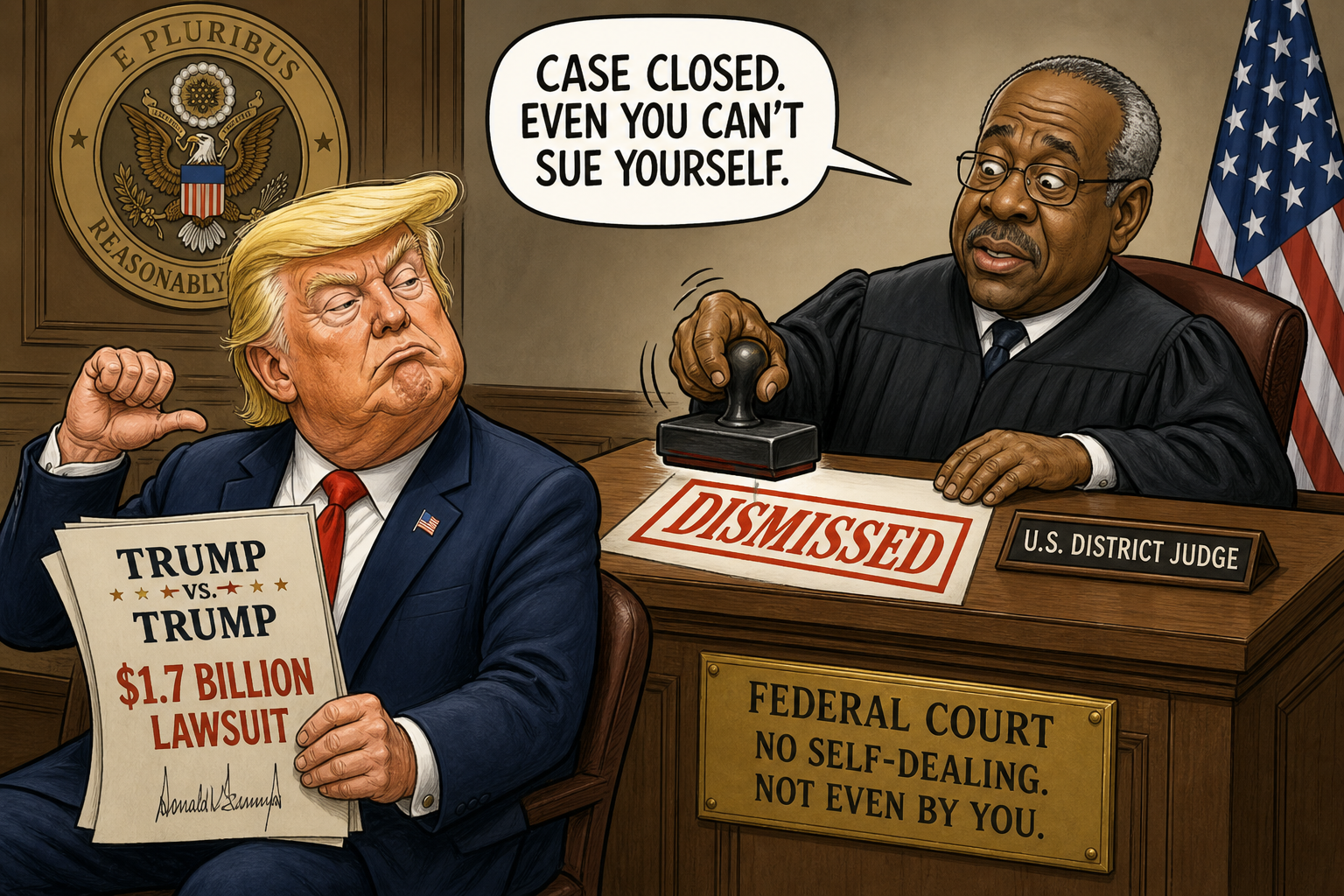
WASHINGTON (TR) — A federal judge in Florida dismissed a $1.7 billion lawsuit Friday, ruling that a plaintiff cannot sue a defendant he also controls. The case was filed in January by Little Donnie Dollhands in his personal capacity against the Internal Revenue Service. The complaint sought damages for the release of his tax returns during his first term. The real goal, according to court filings and the former president's own public statements, was to create a settlement fund for his political allies.
The proposed fund would have paid out to more than 1,600 January 6 defendants. It also listed Rudy Giuliani, Roger Stone, Steve Bannon, and members of the Oath Keepers and Proud Boys as intended beneficiaries. The mechanism was simple: sue the IRS, have the government settle for $1.7 billion, then distribute the money through a panel of five people handpicked by the plaintiff. That panel would have no oversight and could be fired without cause.
The problem, as several outside parties pointed out in briefs, is that the former president admitted he controls both sides of the lawsuit. During a press conference on January 31, 2026, two days after filing, a reporter asked what it was like to be on both sides of a case. The former president responded, "It's very interesting. I have another one where I virtually won the Mara Lago break-in suit. I'm supposed to work out a settlement with myself."
Judge Cecilia Altonaga, assigned to the case after a random draw, issued a 12-page opinion citing Article III standing requirements. "A plaintiff cannot manufacture a dispute by suing an agency he has demonstrated he controls," she wrote. "The court lacks subject-matter jurisdiction when the alleged injury is self-inflicted and the remedy is self-directed."
Justice Department lawyers assigned to defend the IRS declined to comment. One attorney familiar with the case described the "difficulty" of representing a client whose opposing party has fired the agency's commissioner without cause. "We are doing our best," the attorney said, "to argue against a settlement that our client's boss has already announced he wants."
The dismissal leaves open the question of whether the former president can simply set up the slush fund through executive order. The judge noted in a footnote that "nothing in this ruling prevents the plaintiff from writing a $1.7 billion check to any person or organization he chooses, provided those funds exist." The White House did not respond to a request for comment. A follow-up inquiry was forwarded to the Office of Legal Counsel, which placed it on a 90-day review schedule pending budget approval.