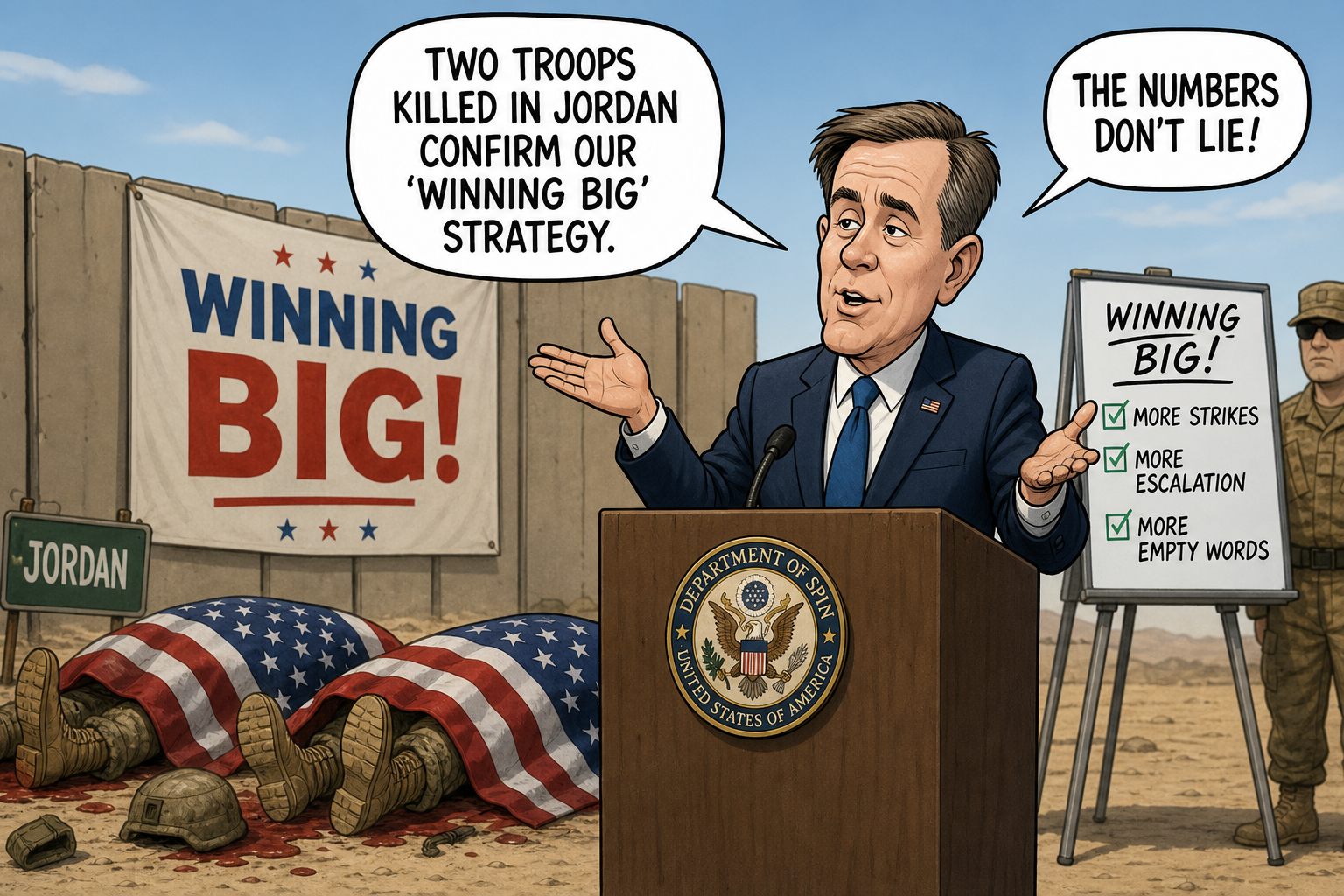
Two U.S. service members were killed and one remains missing after an Iranian ballistic missile attack on a base in Jordan, U.S. Central Command confirmed Friday. The deaths, the first acknowledged American combat fatalities in the region since the conflict widened, were immediately cited by the White House as evidence that the administration's escalation strategy is producing tangible results.
Little Donnie Dollhands, speaking from his Bedminster golf club, told the nation hours earlier that 'the fruits of that labor' would be visible 'very, very shortly.' The fatalities were announced within the day. A White House aide later clarified that the former president was referring to a forthcoming harvest of strategic momentum, not a casualty count.
Central Command described the attack as a 'kinetic friction event' that aligned with the Pentagon's updated definition of battlefield progress. 'These tragic losses demonstrate the operational tempo required to degrade adversarial capabilities,' said CentCom spokesperson Rear Adm. Judith Kelleher. 'We assess that every engagement, even those resulting in sacrifice, moves us closer to a durable security architecture in the region.'
The Pentagon has retooled its public-facing metrics since the war began. The new 'Winning Big Readiness Index' now counts both enemy strikes and U.S. casualties as positive indicators. Under the revised framework, an Iranian ballistic missile hit that kills American troops is scored as a 'direct contact success' because it confirms that the adversary is reacting to U.S. pressure.
Iran's supreme leader, Mojtaba Khamenei, dismissed a recent U.S.-brokered memorandum of understanding as 'not worth the paper it was written on.' He added that the 'great Satan' had revealed its 'true face without a mask.' The statement followed a cycle of strikes in which the U.S. hit a desalination plant in Iran, cutting off water to 20 villages, and Iran retaliated by striking a similar facility in Kuwait that handles 90 percent of the country's crude oil exports.
Administration officials said the tit-for-tat pattern was encouraging. 'If they're hitting desalination plants, it means they're running out of more valuable targets,' a senior defense official said on condition of anonymity. 'We view that as a very big win.'