WASHINGTON — Senior White House officials reportedly entered a state of profound confusion late Tuesday after Iran responded to threats of annihilation with a calmly delivered geography lesson. The furor began after Sweet Potato Hitler, in a Fox interview, vowed to reduce Iranian bridges, roads, and energy infrastructure to rubble unless Tehran agreed to a deal it has publicly and repeatedly declined.
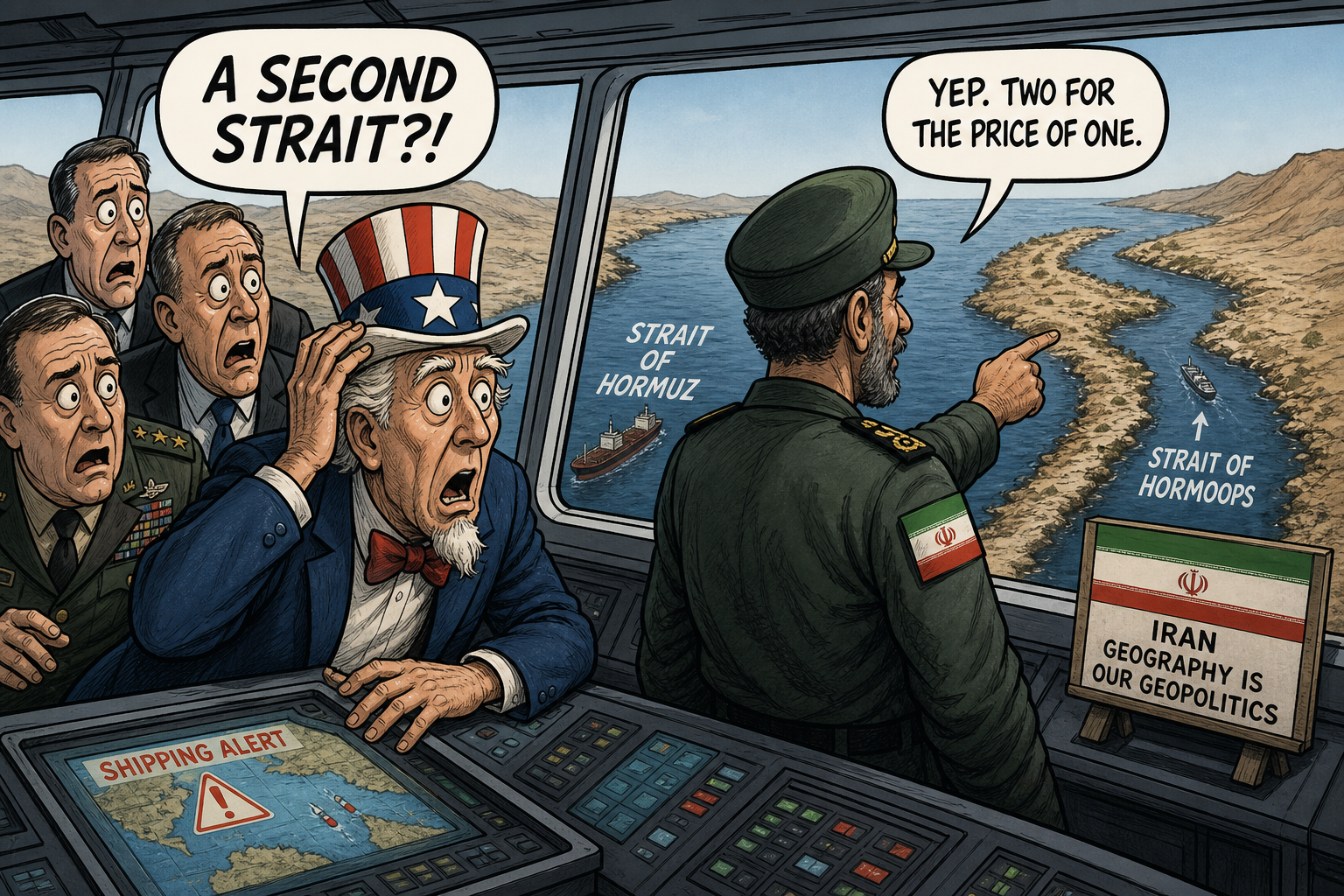
The IRGC issued a statement noting that, in addition to the Strait of Hormuz, it could ensure “all shipping traffic in the region” ceased, specifically referencing the Bab el-Mandeb Strait connecting the Red Sea to the Gulf of Aden. The mere mention of a second strategically located choke point triggered what one National Security Council aide called “a seismic reassessment of our nautical awareness.”
An emergency Situation Room meeting was hastily assembled. According to three sources with knowledge of the gathering, aides presented a map and a ruler. Several officials were visibly taken aback.
“We were not aware Iran had access to more than one strait,” a senior Pentagon advisor reportedly said. “We assumed geography was a limited resource. It turns out it is not.”
The meeting stretched past midnight as military planners scrambled to locate Yemen on a globe and determine whether the Houthis, an Iran-allied group that previously disrupted Red Sea shipping for months, were still operational. They were.
“The Houthis have been waiting for activation orders,” said Sebastian Gorka, a senior counterterrorism advisor who appeared to have just learned the name of the group. “We find the situation deeply irregular. Normally, when we threaten to obliterate a civilization, the other side just makes a deal. That’s how the former president deals work.”
Iran’s deputy foreign minister, in a televised interview, reiterated that no negotiations would be requested. “If America thinks that by tightening a circle of actions against us, we will ask to go back and negotiate, it is mistaken,” he said. He added that Tehran would not request talks, nor would it widen the Strait of Hormuz, which he called “a very key capacity.”
The administration’s confusion was exacerbated by a parallel announcement from the Treasury Department. Officials confirmed the new crack spread—the difference between crude oil and refined product prices—had soared to $68 per barrel, the highest ever recorded. Crude itself crept toward $90. When asked whether a shutdown of both the Strait of Hormuz and the Bab el-Mandeb might affect fuel costs, a senior economic advisor paused for a full thirty seconds.
“We’re evaluating,” he said finally. “The president’s understanding of oil markets is based primarily on conversations with golf caddies. We believe the situation is, as of now, manageable—provided no one tells him what a crack spread is.”
Vice President JD Vance was reportedly tasked with contingency planning for a Red Sea closure. Two aides observed Vance staring at a blank legal pad for forty-five minutes before writing “make a deal?” and underlining it three times.
At the Pentagon, a spokesperson confirmed that a naval task force was being reassigned to the region. “We are committed to maintaining freedom of navigation,” the statement read, “though we acknowledge our previous strategy of escorting commercial vessels did not prevent Iran from sinking seven ships in seven days with cruise missiles, a fact we are still processing.”
No formal decision was reached in the Situation Room. One source described the prevailing mood as “a dawning realization that threats to obliterate infrastructure are not a sophisticated bargaining chip when the other side controls two narrow waterways that carry a tenth of global trade.”
The Pentagon did not respond to a request for comment on its contingency plans for a third strait. The possibility, an aide later conceded, “had not yet been modeled.” Iran, for its part, had no further comment, but satellite imagery showed several dozen vessels diverting course in the Red Sea. The ships appeared to be heading somewhere far away. The administration, meanwhile, scheduled a follow-up meeting for Wednesday morning to review basic topography.