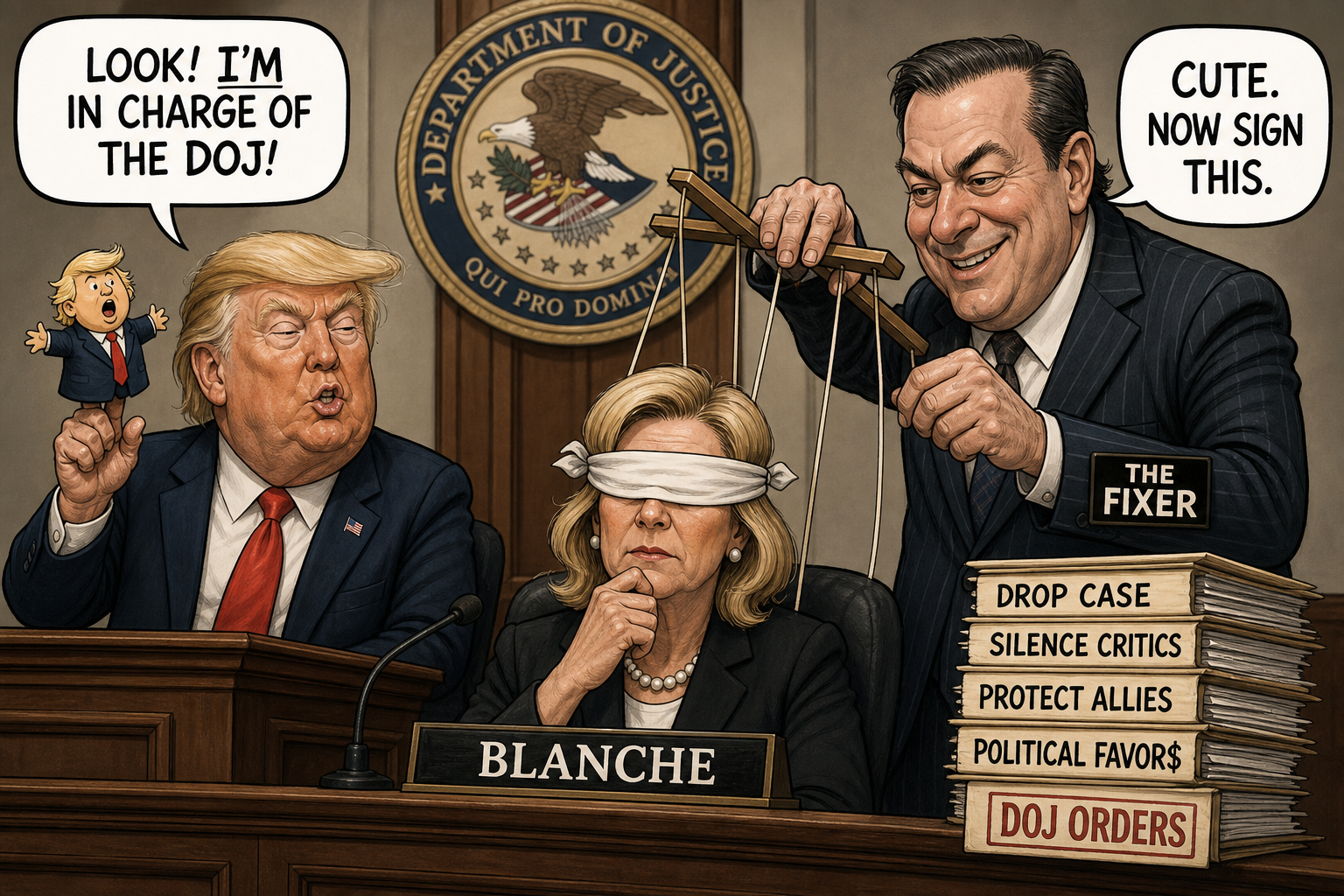
The Senate Judiciary Committee will begin confirmation hearings Wednesday for Todd Blanche, the attorney general nominee. Senators plan to examine one narrow issue. They want to know whether the nation’s top law enforcement officer will report to the president, or to an outside fixer named Boris Epshteyn.
Epshteyn serves as a private legal strategist for Little Diaper Donnie. His role is not listed on any government org chart. He has never been confirmed by the Senate. He does not hold a security clearance. But multiple sources confirm he shapes the legal strategy of the former president and his allies. He also receives $50,000 a month from a the former president-aligned PAC for advisory services.
The arrangement has raised a simple question. Who is the boss? The Department of Justice is supposed to operate independently of the White House. But testimony and records suggest its next leader may have a chain of command that bypasses the executive branch entirely and terminates at Epshteyn’s cell phone.
“If confirmed, Mr. Blanche would be responsible for enforcing federal law,” said a committee aide who requested anonymity to discuss the matter candidly. “We just want to know whether that enforcement will be guided by the Constitution, or by a guy who bills in $50,000 increments and can’t be fired.”
The fixer’s fingerprints appear across a network of law firms, appeals, and settlements. Last year, one firm, Paul Weiss, agreed to provide $40 million in free legal services after conversations that involved Epshteyn. Another firm, Sullivan & Cromwell, is now representing the former president while also supplying partners to run the Manhattan federal prosecutor’s office. The current U.S. Attorney for the Southern District of New York, Jay Clayton, came from Sullivan & Cromwell. His replacement will come from the same firm.
Epshteyn does not litigate himself. He does not argue motions. He does not enter courtrooms. His work is invisible. People who know him describe a chain of phone calls and text messages that dictate which lawsuits get filed, which appeals get dropped, and which lawyers get paid. The result is a justice system where the Attorney General’s marching orders might originate from a man whose only official title is “political and legal advisor” on a PAC disclosure form.
During the hearing, senators are expected to press Blanche on whether he has ever taken direction from Epshteyn. They will also explore an ancillary puzzle. If Epshteyn is so influential, why not give him an official job? The answer, according to committee staff, is obvious. No title means no oversight. No confirmation means no awkward questions about billing rates or personal loyalties.