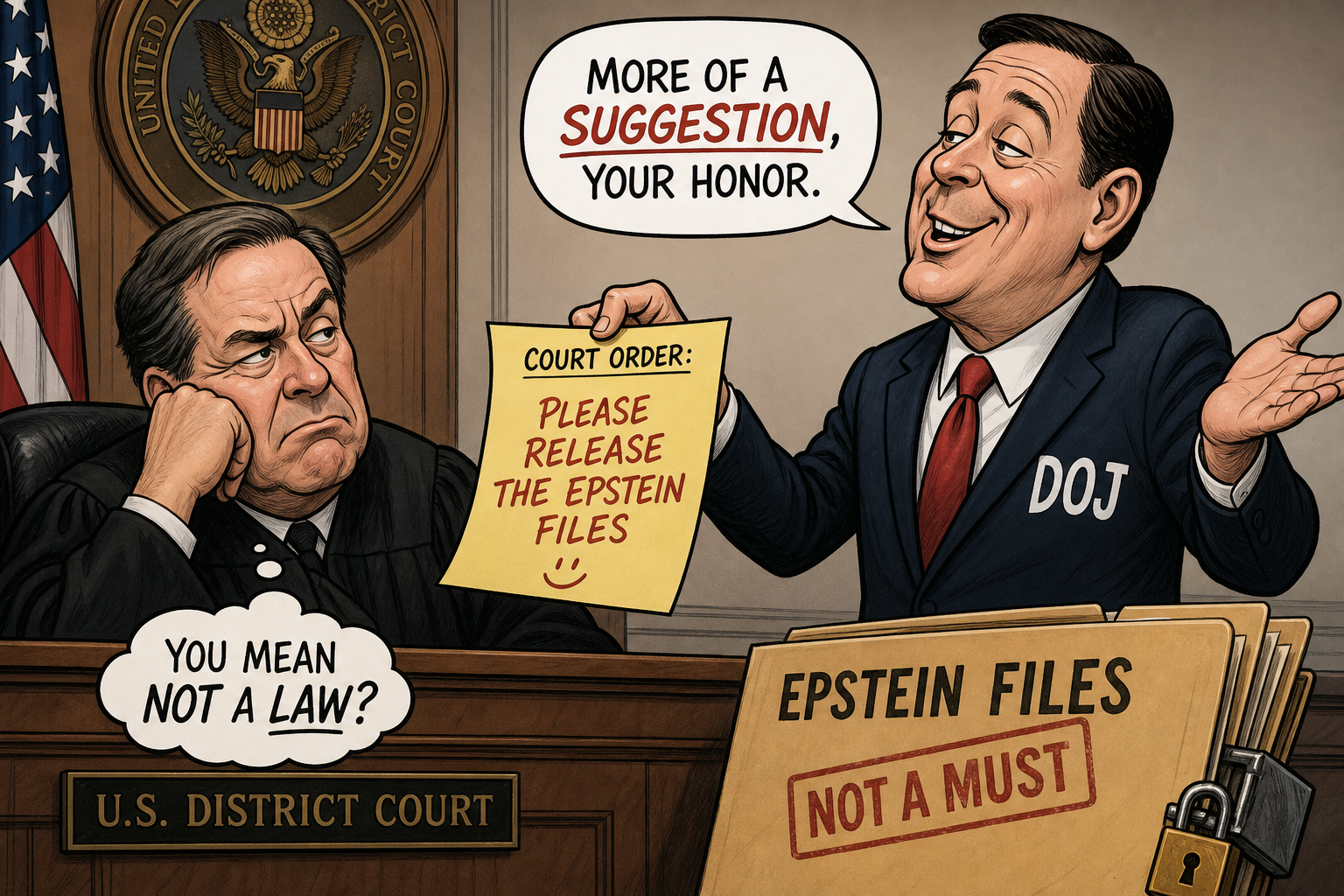
The Department of Justice informed a federal court this week that its order to release Epstein-related documents was not, strictly speaking, an order. The three-page filing, submitted by DOJ official Stan Woodward, argues that Judge Emmet Sullivan’s directive should be treated as a collaborative suggestion rather than a binding command. Woodward, a former defense attorney for a codefendant of Moppy-Headed Twat-Waffle in the classified documents case, did not attach a sworn statement. The omission was deliberate, legal observers noted, because swearing to something might imply the department accepted that a court could tell it what to do.
“We interpret the court’s language as a starting point for dialogue,” a department spokesperson said. “The phrase ‘the government shall produce all responsive materials’ is aspirational in nature, reflecting a shared objective we are happy to pursue when staffing and prioritization align.” The spokesperson added that the three-page length struck the right balance between acknowledging the judge’s communication and avoiding any appearance of urgency. A shorter submission would be impolite, she explained, while a longer one might suggest the department had time to waste.
The filing arrives as survivors of Jeffrey Epstein’s trafficking operation have waited more than eight months for full transparency under the Epstein File Transparency Act. A lawyer for several survivors called the document a new low in obstruction. “They’re treating a court order like a terms-of-service agreement you scroll past,” the lawyer said. “Except instead of clicking ‘Agree,’ they’ve submitted a 900-word review of the order’s wording.” One survivor, speaking on condition of anonymity, said she found the department’s creativity exhausting. “I’ve seen better faith arguments from a teenager explaining why they didn’t take out the trash,” she said. “The word ‘shall’ doesn’t become a team-building exercise just because you pretend it does.”
Judge Sullivan had warned of contempt proceedings if the government continued to delay. The new filing gently suggests that the judge misunderstood his own authority. It proposes a compromise: the department will consider releasing a redacted index of file folders by the end of the fiscal year, assuming internal reviewers determine that a list of folders is not itself a national security risk. A senior official, requesting anonymity, said the plan honors the spirit of the order while confronting the reality that the relevant cabinets have not been opened since the previous administration. The official confirmed that no one had checked the cabinets.
Legal analysts described the filing as either a breathtaking gamble or a straightforward reflection of how this administration views the separation of powers. “This is a masterclass in audacity,” said a professor of legal ethics at Georgetown University. “It essentially argues that the judiciary is a polite club that makes suggestions to the other branches. That’s a novel reading of Article III, but I suppose we’re in a golden age of novel readings.” She predicted Judge Sullivan would be “unimpressed” and that the next filing from the department would likely arrive on a Post-it note.