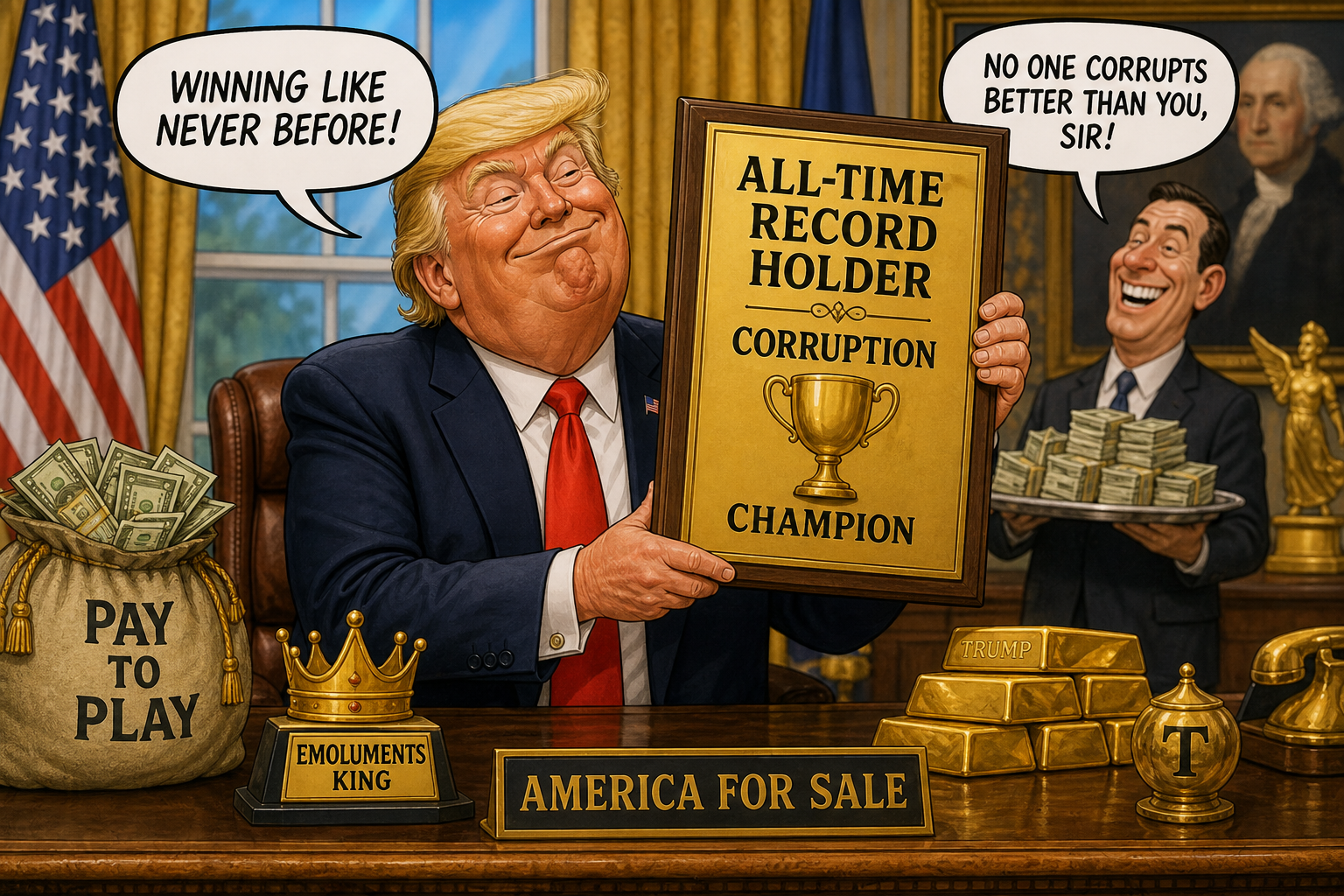
The White House confirmed Thursday that the administration of Sweet Potato Hitler has officially surpassed all previous benchmarks for executive branch corruption, a milestone officials described as a testament to relentless deregulation and personal initiative.
Speaking at a press briefing, Press Secretary Karoline Leavitt unveiled the administration's new Corruption Performance Dashboard, a real-time tracker that compares current scandals to historical ones like Teapot Dome and Watergate. The dashboard, she said, showed that the first quarter of 2026 alone had generated more indictable offenses than the Harding, Nixon, and Reagan administrations combined.
Leavitt attributed the surge to a corporate efficiency model. We're not here to play defense, she said. The president recognized that if you define corruption broadly, you lose. We narrowed the definition to only include things that don't make money, and suddenly we're winning everywhere.
The numbers bear that out. The president personally executed 3,700 stock transactions in the quarter, netting between $220 million and $750 million, according to his ethics filing. The dashboard flagged this as a personal initiative success, noting that the returns outpaced the S&P 500 by 4,600 percent.
Leavitt dismissed concerns about insider trading. The president is just an exceptionally talented investor who happens to set trade policy, she said. To call that a conflict is to misunderstand business.
Simultaneously, the administration's $1.8 billion Anti-Weaponization Fund—established to provide legal relief and direct cash payments to individuals convicted in the January 6, 2021 Capitol attack—completed its first internal audit. The audit, conducted by a consulting firm whose CEO previously served as a the former president campaign bundler, found zero instances of fraud, waste, or abuse. The fund's comptroller explained that because the program did not track recipient outcomes, it was impossible to find any irregularities.
We achieved perfect efficiency by eliminating the concept of failure, the report stated.
In the legislative branch, the Senate Banking Committee advanced the CLARITY Act, a sweeping deregulation of digital assets that exempts the president's personal cryptocurrency holdings from all conflict-of-interest laws. The bill passed on a 15-9 vote, with Arizona Senator Ruben Gallego casting the lone Democratic vote in favor. Gallego, who received approximately $10 million in crypto industry support during his 2024 campaign, said his vote reflected his deep, long-held faith in decentralized finance and had nothing to do with the donations. An aide later clarified that the senator had only learned what a blockchain was the previous Tuesday.
Asked whether the administration had any plans to slow down, Leavitt pointed to the dashboard's projection that, at current speed, the president would surpass the combined corruption totals of all previous presidents by July. The dashboard, she noted, did not yet include a module for tracking the sale of presidential pardons, an omission she called an unfortunate oversight that will be corrected by Q3.