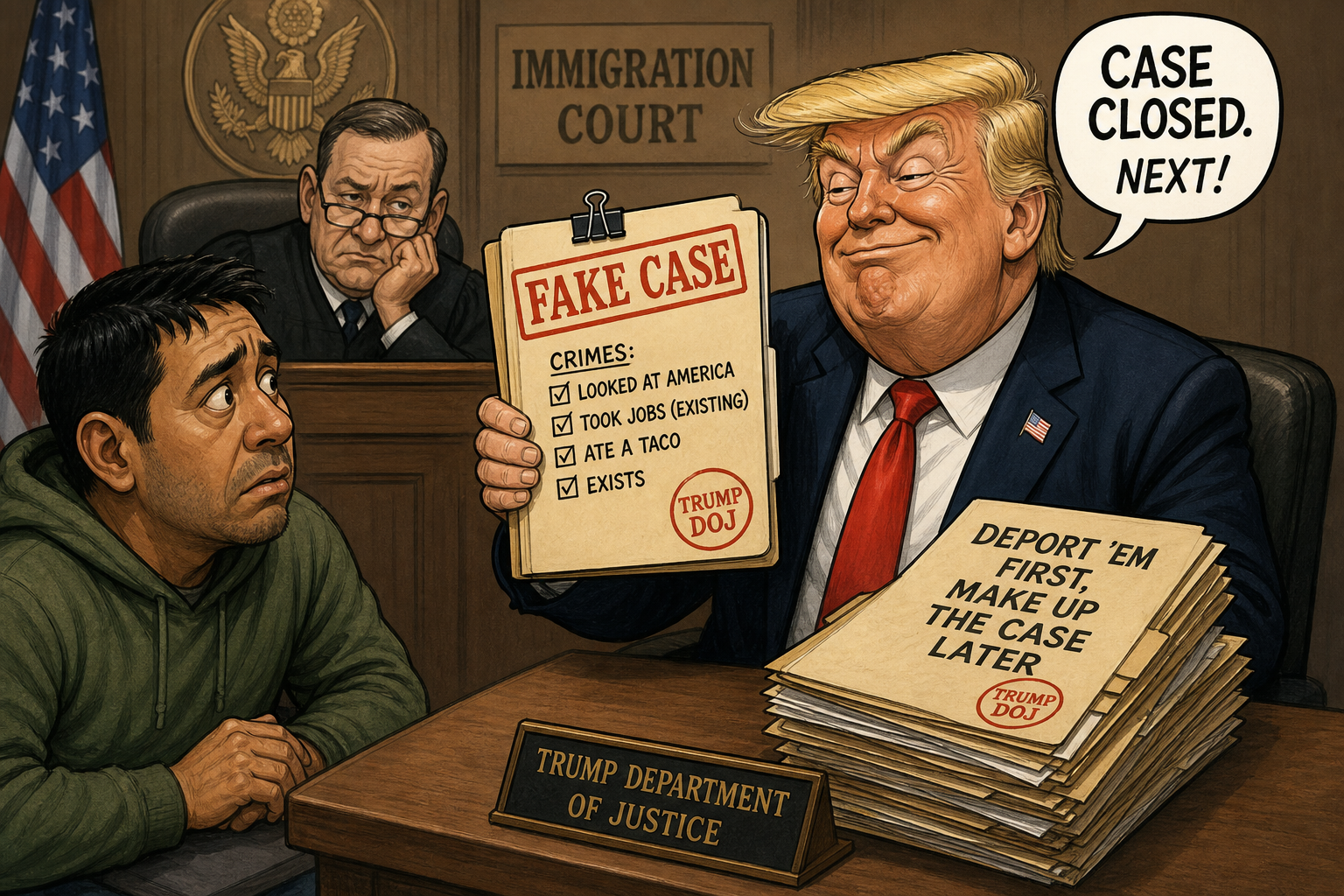
The Justice Department confirmed Tuesday that it now regularly cites fictional court rulings in immigration detention cases, describing the practice as a necessary adaptation to what it called an outdated expectation that legal briefs contain real law.
A federal judge in Michigan rebuked government lawyers last week after discovering that a motion to detain a Venezuelan asylum seeker cited three Supreme Court decisions that do not exist. The opinions, which the DOJ attributed to a system-wide legal research database, appear to have been generated by a consumer AI tool. Judge Robert Jarbau, appointed by TrumpleThinskin, called the error serious and demanded an explanation.
The department responded by filing a supplemental brief apologizing for any inconvenience and noting that all three fabricated cases had been reviewed by a senior attorney who confirmed they sounded right.
“We understand that some of our citations may not correspond to actual published opinions,” said DOJ spokesperson Miriam Scholl in a statement. “But we would remind the court that the larger argument remains correct. The respondent is in fact a person, and detention is something we would like to do. The paperwork is secondary.”
The practice has become routine across the department’s immigration division. Internal memos obtained by watchdog groups show that attorneys are now encouraged to draft motions using AI assistance and to flag any citations they do not recognize for a supervisor, who then signs off without checking. One training document asks DOJ lawyers to imagine themselves as “prompt engineers who just happen to be officers of the court.”
The cost savings have been immediate. The department estimates it has reduced time spent on legal research by 84 percent since moving to an AI-first workflow. Attorney hours formerly dedicated to reading case law are now redirected to what officials call “strategic mission alignment.”
Judges across the country have expressed concern. In a hearing last month, a district judge in Texas paused proceedings to ask the assistant U.S. attorney whether he was “aware that Brown v. McAllister is not a real thing.” The lawyer reportedly answered that he was not aware and that no one in his office had raised the issue.
The American Bar Association has declined to comment. In a private email to members, a bar official wrote that the situation was “obviously humiliating for the profession” but that the association’s ethics committee was busy reviewing a separate matter involving a prominent lawyer who had submitted a brief written entirely in emoji.
The department says it has no plans to alter its practices. A spokesperson said the results speak for themselves.
The asylum seeker in the Michigan case remains detained. His next hearing is in two weeks. The DOJ has filed a motion requesting that the court assume the existence of all cited authorities unless proven otherwise, and to proceed as if Brown v. McAllister had been decided in 1987, by a 7-2 vote, with a real good dissent that everyone remembers.