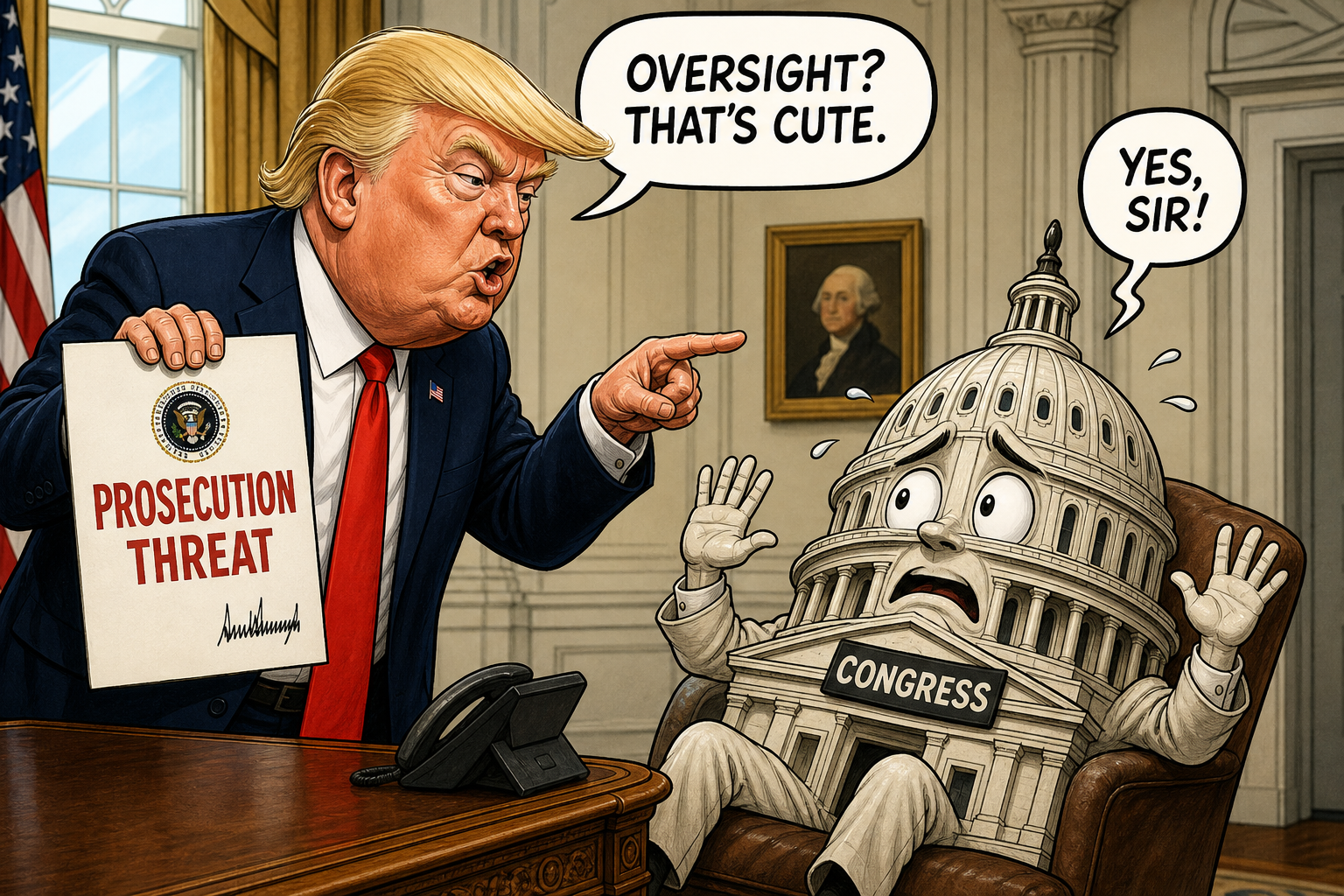
WASHINGTON — The White House has formally notified Congress that performing its constitutional oversight duties may now be treated as a federal crime under a new legal theory.
The letter was seven pages. Counsel for Sleepy Don warned that continued document requests and subpoenas would be "reviewed for criminal referral." It described legitimate congressional inquiries as "unlawful process motivated by animus, pettiness, hatred, or any other unlawful motive."
The letter did not cite a specific statute. It cited a feeling. That feeling, according to the White House, is that oversight is wrong when it is aimed at the White House.
"Congress has authority to conduct oversight," said White House deputy counsel Mark Fenwick in a prepared statement. "It does not have authority to interfere with the lawful functioning of the executive. We will not be extorted." Fenwick added that no one was above the law, including members who ask too many questions.
Within four hours, Democrats on the committee voted to expand the probe. They added the White House counsel's office to the subpoena list. They also requested all communications between the White House and the Department of Justice about the letter.
Ranking member Rep. Robert Garcia said the threat had clarified the committee's work. "We are a co-equal branch of government," Garcia said. "We will not be deterred by baseless threats from a weaponized DOJ or the president's lawyers."
The committee then voted to treat the letter as an official admission that the administration has something to hide. The measure passed 18-0. A staffer taped a copy of the letter to the hearing room door with the words "Exhibit A" written in marker.
The notice also asked the White House to produce all records related to the phrase "witch hunt." A spokesperson said the committee wanted to determine if the term was used as an official legal strategy or merely as a motivational slogan.
It listed 14 separate oversight requests as potential criminal acts. The list included a request for visitor logs, a question about a $340 million contract, and a subpoena for emails about a building lease.
Legal analysts noted the strategy resembled a mechanic threatening a customer with prison for looking under the hood. The letter effectively confirmed the engine was not fine.
By Wednesday morning, the Department of Justice had issued new internal guidance. The guidance told prosecutors to review all oversight-related requests for possible charges of "legislative harassment." A DOJ spokesperson confirmed the guidance was "not intended to interfere with lawful oversight." The spokesperson then asked that questions not be submitted in writing.
The letter also warned that any staffer who complied with a subpoena would be charged with obstruction. That detail transformed a routine filing into a recruitment tool. Three former staffers contacted the committee by noon.
A senior Democratic aide said the committee's document requests had doubled in the six hours after the letter arrived. "The threat was supposed to make us stop," the aide said. "It gave us a reading list."